
Getting your mortgage application right the first time means having every document, number, and decision in order before you ever speak to a broker. A disorganized application can delay your closing, trigger additional verification requests, or — in competitive markets — cost you the home entirely.
This guide covers the top tools homebuyers and homeowners use to build a bulletproof mortgage application checklist: from soft-pull pre-qualification services that protect your credit score to document organizers, budget calculators, and credit monitoring platforms. Whether you’re a first-time buyer in Richmond, VA, or refinancing a home in Florida or Tennessee, these tools help you walk into the process prepared, confident, and clear on your true total cost of ownership — not just your monthly payment.
By Duane Buziak, NMLS #1110647 | Coast2Coast Mortgage LLC, NMLS #376205 | Equal Housing Opportunity
1. Better Mortgage Rates — NoTouch Credit Pre-Qualification
Best for: Homebuyers and refinancers who want to shop hundreds of lenders without a credit hit
Better Mortgage Rates is a broker-operated pre-qualification service using Vantage Score 4.0 to shop hundreds of lenders simultaneously with no hard inquiry and no credit score impact.

Where This Tool Shines
Most buyers don’t realize that shopping multiple lenders can trigger multiple hard inquiries — each one capable of nudging your credit score down at exactly the wrong moment. The NoTouch Credit model solves this by using a soft credit pull mortgage approach through Vantage Score 4.0, which reads your full credit profile without leaving a footprint on your report.
What sets this apart from simply checking your own credit is that it simultaneously submits your profile across hundreds of lender options, so you’re not just getting a ballpark — you’re getting real competitive positioning before you’ve committed to anything. For buyers in Virginia, Florida, Tennessee, and Georgia, this is the logical first step before any other checklist item.
Key Features
NoTouch Credit Pull: Uses Vantage Score 4.0 for a true soft inquiry — your credit score is not impacted at any point during pre-qualification.
Multi-Lender Shopping: A single application submission is compared across hundreds of lenders, maximizing rate competition on your behalf.
Cash-Out Refinance Access: Eligible homeowners can access cash-out refinances up to 90% LTV — higher than many standard broker offerings.
24/7 Availability and Fast Closings: Applications can be started at any time, with some of the fastest close timelines available in the current market.
Realtor Referral Program: Real estate professionals can refer clients directly, creating a coordinated experience between agent and broker from offer to close.
Best For
First-time buyers who want to understand their options before committing, homeowners exploring a refinance, and anyone who has been hesitant to apply because they’re worried about credit score impact. Also ideal for buyers working with a Realtor who wants their clients pre-qualified quickly and cleanly.
Pricing
Pre-qualification consultation is free. Broker fees vary by loan program and are disclosed transparently in the Loan Estimate you receive within three business days of application.
2. AnnualCreditReport.com
Best for: Every mortgage applicant who needs to review their credit before a lender does
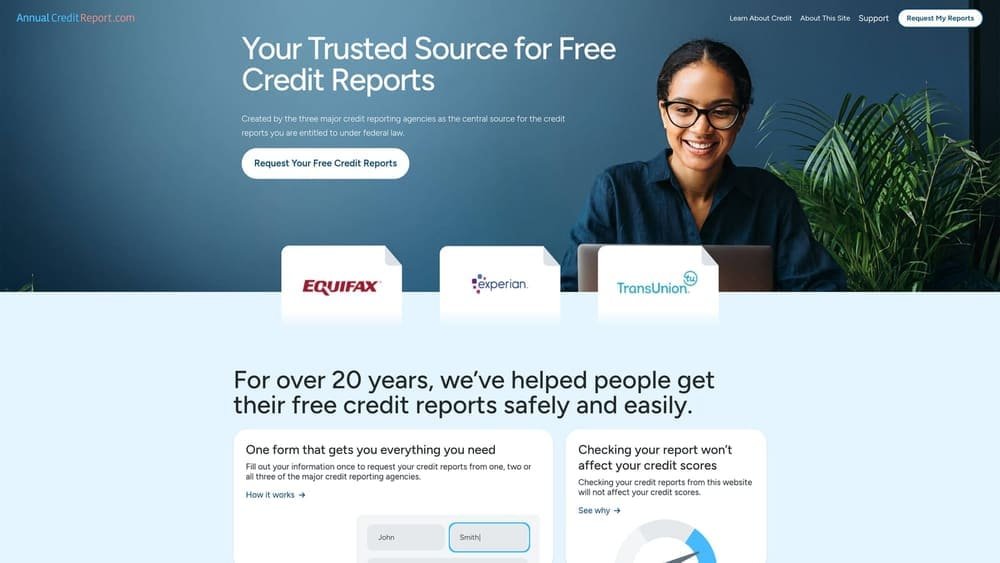
AnnualCreditReport.com is the only federally authorized source for free credit reports from all three major bureaus, mandated under the Fair Credit Reporting Act.
Where This Tool Shines
Before any broker or underwriter pulls your credit, you should know exactly what they’re going to see. Errors on credit reports are more common than most people expect — incorrect balances, accounts that don’t belong to you, or derogatory marks that should have aged off. Finding and disputing these before your application can be the difference between qualifying at a preferred rate and being asked to wait.
This is your baseline. Pull all three bureaus — Equifax, Experian, and TransUnion — because lenders often use the middle score of all three, and a single bureau error can drag your qualifying score down unnecessarily.
Key Features
All Three Bureau Reports: Access Equifax, Experian, and TransUnion reports from a single source — the only federally authorized platform to do so for free.
Weekly Free Access: Free weekly access has been extended as a policy; verify the current access schedule at AnnualCreditReport.com at time of use.
Error Identification: Reviewing your reports before application gives you time to dispute inaccuracies through each bureau’s formal dispute process.
No Subscription Required: This is a government-mandated free service — there is no paid tier, no upsell, and no account required to access your reports.
Best For
Every mortgage applicant, without exception. Pull your reports at least 60 to 90 days before you plan to apply — disputes can take 30 days or more to resolve, and you want that time buffer before your broker submits your file to underwriting.
Pricing
Free. No subscription, no credit card, no paid tier.
3. IRS Get Transcript
Best for: W-2 employees and self-employed borrowers who need official income documentation fast
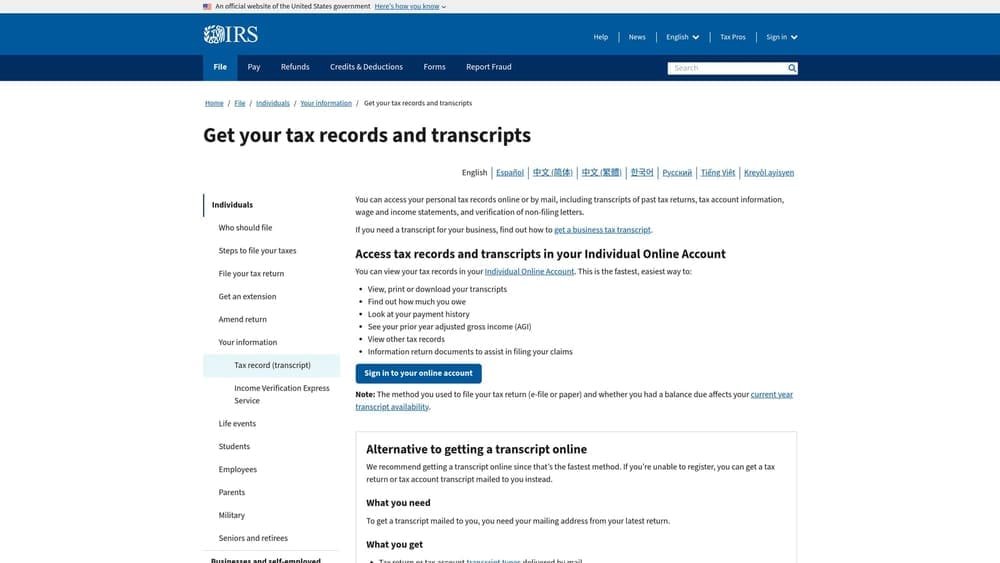
IRS Get Transcript is the official IRS online tool for retrieving tax return transcripts, W-2 records, and wage and income documentation — the exact income verification documents lenders require.
Where This Tool Shines
Most lenders require two years of tax returns for income verification. If you can’t locate your paper copies or your tax preparer is unavailable, the IRS Get Transcript tool delivers official records instantly online. For self-employed borrowers, this is especially critical — 1099 income, Schedule C filings, and business returns are all retrievable here, and income documentation is one of the most common bottlenecks in self-employed mortgage applications.
The transcript you download is accepted by all mortgage lenders as official documentation. It carries the same weight as a paper return filed with the IRS, and it arrives in minutes rather than weeks.
Key Features
Tax Return Transcripts: Retrieve the last two years of filed returns instantly — the standard requirement for most conventional and government-backed loan programs.
Wage and Income Transcripts: Covers W-2s, 1099s, and other income forms reported to the IRS — useful for verifying all income sources.
24/7 Availability: Access your transcripts any time without waiting for paper copies or contacting the IRS by phone.
Identity Verification: Requires verification via an IRS online account or ID.me — a one-time setup that protects your records.
Lender Acceptance: Accepted as official income documentation by all mortgage lenders and underwriters.
Best For
Anyone in the mortgage process — but especially self-employed borrowers, gig workers, and applicants with multiple income sources who need clean, official documentation of every income stream before submitting their file.
Pricing
Free. Official government service with no fees at any stage.
4. CFPB Loan Estimate Explainer
Best for: First-time buyers who want to understand every line of their Loan Estimate before comparing offers
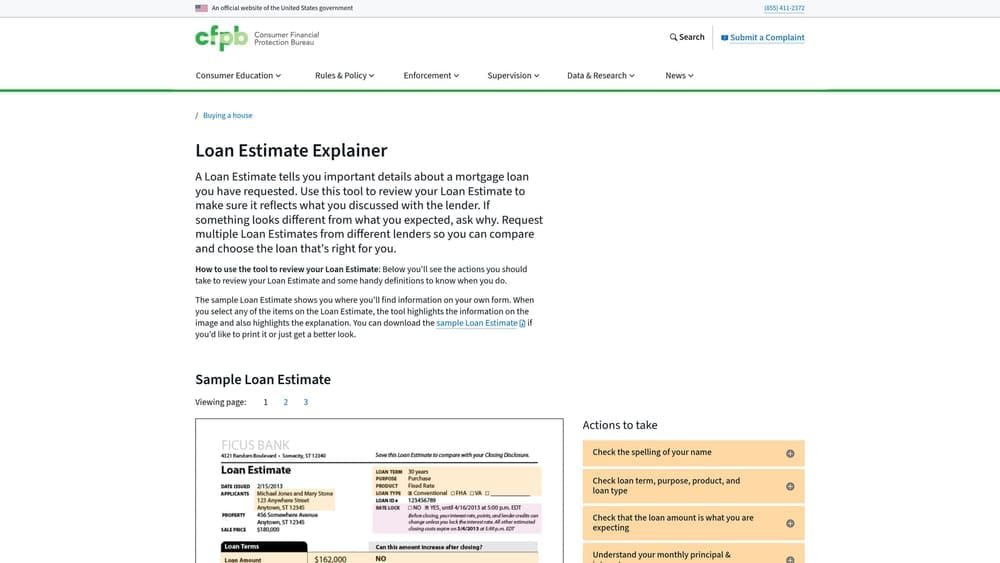
The CFPB Loan Estimate Explainer is the Consumer Financial Protection Bureau’s plain-language guide to the standardized Loan Estimate form every lender is required to provide within three business days of application.
Where This Tool Shines
The Loan Estimate is a three-page form that contains more financial information than most buyers are prepared to interpret on their first read. The CFPB’s interactive explainer walks through every line item — APR versus interest rate, origination charges, prepaid interest, escrow setup, and cash to close — in plain language with no sales agenda attached.
This tool is particularly valuable when you’re comparing Loan Estimates from multiple brokers side by side. Knowing which line items are negotiable, which are fixed by law, and which vary by lender lets you make a genuinely informed comparison rather than just looking at the rate.
Key Features
Line-by-Line Explanation: Every field on the standardized Loan Estimate form is explained in plain language, with context for what it means and why it matters.
APR vs. Rate Clarification: Explains why the APR is always higher than the stated interest rate and what that difference actually represents in cost.
Lender-Neutral: Published by a federal consumer protection agency — there is no sales motivation, no affiliate relationship, and no preferred lender being promoted.
Multi-Broker Comparison Support: Helps buyers compare Loan Estimates across multiple brokers accurately, identifying where costs differ and why.
Best For
First-time buyers, anyone who has received a Loan Estimate and felt uncertain about what they were reading, and buyers comparing offers from more than one broker who want to understand what they’re actually comparing.
Pricing
Free. Published by the U.S. Consumer Financial Protection Bureau.
5. Google Drive / Microsoft OneDrive
Best for: Organizing, storing, and securely sharing your complete mortgage document package
Google Drive and Microsoft OneDrive are cloud storage platforms widely used by mortgage applicants to organize and securely share the full document package required for underwriting.
Where This Tool Shines
A mortgage application involves a significant volume of documents: 30 days of pay stubs, two years of W-2s, two years of tax returns, two to three months of bank statements, gift letters, photo ID, and insurance declarations — at minimum. Without a clear organizational system, applicants frequently submit outdated documents, miss files entirely, or send the wrong version of a statement to their broker.
Building a structured folder system in Google Drive or OneDrive before you start gathering documents solves this. A simple structure — Income, Assets, Property, Identity — means every document has a home, and sharing a view-only folder link with your broker is faster and more controlled than email attachments.
Key Features
Secure Folder Organization: Create clearly labeled folders for each document category so nothing gets lost or confused during the application process.
Controlled Sharing: Share folders or individual files with view-only or edit permissions — your broker sees exactly what you intend, nothing more.
Version Control: Uploading updated documents replaces older versions, preventing the common error of a lender working from a two-month-old bank statement.
Storage Tiers: Google Drive provides 15GB free; OneDrive provides 5GB free with additional storage available through Microsoft 365 subscriptions.
Best For
Any mortgage applicant who wants a clean, organized document package ready to share with a broker on request. Particularly useful for co-borrowers who need to consolidate documents from two separate people into one organized submission.
Pricing
Free tier available on both platforms. Paid plans start at approximately $1.99 to $9.99 per month depending on storage needs — most mortgage applicants will not need to upgrade from the free tier.
6. YNAB (You Need a Budget)
Best for: Applicants who need to calculate, understand, and improve their debt-to-income ratio before applying
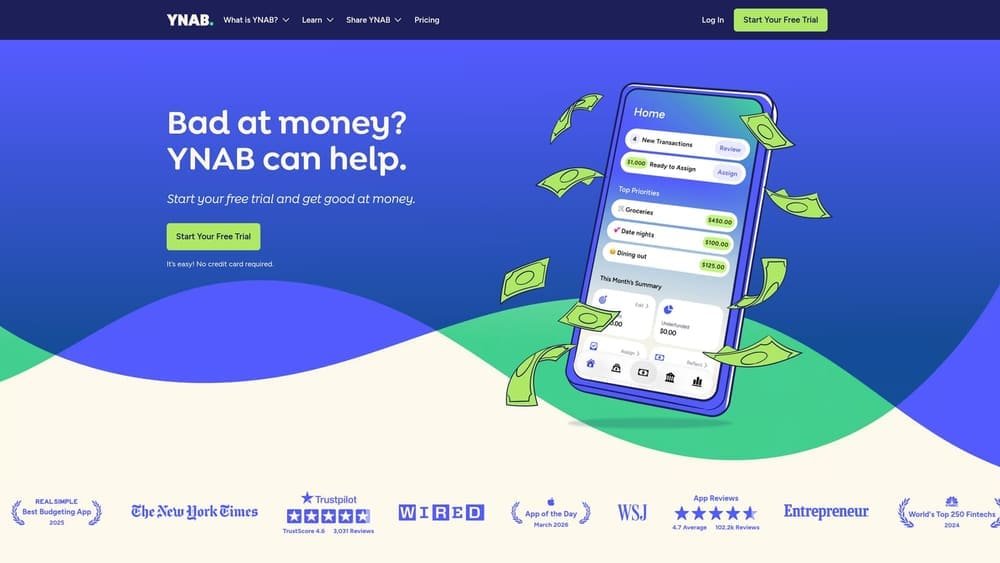
YNAB is a subscription budgeting tool that tracks all recurring monthly obligations in real time — a critical step for understanding and improving your debt-to-income ratio before submitting a mortgage application.
Where This Tool Shines
Debt-to-income ratio is one of the primary factors underwriters evaluate. Many applicants underestimate their monthly obligations because recurring charges — streaming services, gym memberships, subscription software, minimum payments on store cards — accumulate quietly and don’t feel like “debt.” But underwriters count every recurring obligation, and YNAB surfaces all of them in one place.
Beyond just showing you the number, YNAB’s goal-setting features help applicants build a targeted debt paydown plan in the months before applying. Reducing one or two recurring obligations before submitting can meaningfully shift your DTI ratio in the right direction.
Key Features
Real-Time Debt Tracking: Connects to your accounts and tracks every recurring monthly obligation — the complete picture underwriters will calculate when reviewing your file.
Hidden Charge Discovery: Surfaces recurring subscriptions and charges that applicants often forget to include when estimating their monthly obligations manually.
Goal-Setting Tools: Allows applicants to set targeted debt paydown goals with a clear timeline — useful for improving DTI before application.
Monthly Trend Reports: Detailed month-over-month income and expense reports mirror the kind of financial picture lenders examine during underwriting.
Best For
Applicants who are three to six months away from applying and want to actively improve their financial profile. Also useful for anyone who has been declined or quoted a higher rate due to DTI and wants a structured way to address it.
Pricing
Approximately $14.99 per month or around $99 per year. Verify current pricing at youneedabudget.com before subscribing.
7. DocuSign
Best for: Signing mortgage disclosures, authorization forms, and purchase agreements from any device
DocuSign is the industry-standard eSignature platform for signing legally binding mortgage documents, compliant with the ESIGN Act and the Uniform Electronic Transactions Act (UETA).
Where This Tool Shines
Modern mortgage closings involve a significant volume of signed documents — initial disclosures, authorization forms, rate lock agreements, and purchase contracts — often on tight timelines. DocuSign allows you to review and sign all of these from any device, at any time, without printing a single page or scheduling an in-person appointment.
For co-borrowers in different locations, or buyers who are relocating from out of state, DocuSign removes a genuine logistical obstacle. Every signed document generates a complete audit trail that satisfies lender compliance requirements.
Key Features
Legally Binding eSignatures: Accepted by mortgage lenders and brokers nationwide under the ESIGN Act and UETA — the same legal standing as a wet signature.
Complete Audit Trail: Every signature event is logged with a timestamp and IP address, creating a compliance record that satisfies lender and regulatory requirements.
Mobile-Friendly: Sign from a smartphone, tablet, or desktop — no special software installation required.
Co-Borrower Coordination: Send documents to multiple signers in sequence or simultaneously, with automated reminders for outstanding signatures.
Best For
Any mortgage applicant, but especially co-borrowers in different locations, remote buyers, and anyone working on a tight timeline where overnight mail or in-person signing would create delays.
Pricing
Personal plans start at approximately $15 per month. Verify current pricing at docusign.com before subscribing.
8. VA.gov COE Portal
Best for: Veterans, active-duty service members, and eligible surviving spouses applying for a VA home loan
The VA.gov COE Portal is the official U.S. Department of Veterans Affairs platform for requesting a Certificate of Eligibility — the required document for any VA home loan application.
Where This Tool Shines
No VA loan can be processed without a Certificate of Eligibility. It is the document that confirms your entitlement to the VA loan benefit, and waiting for it after you’ve already found a home is one of the most common causes of delay in VA loan closings. Applying through the VA.gov portal before you begin your home search eliminates this bottleneck entirely.
The online application is typically processed faster than submitting paper Form 26-1880 by mail. Eligible surviving spouses should also apply here — the portal covers all eligible categories, and the VA.gov website is the authoritative source for current eligibility requirements.
Key Features
Official COE Source: The only official government portal for requesting your Certificate of Eligibility — required before any VA loan can be processed by a lender or broker.
Covers All Eligible Categories: Veterans, active-duty service members, National Guard members, reservists, and eligible surviving spouses can all apply through this portal.
Faster Than Paper: Online applications are typically processed more quickly than paper Form 26-1880 submissions, reducing the most common VA loan delay.
Eliminates Closing Delays: Having your COE in hand before you make an offer removes the most frequent administrative bottleneck in VA loan closings.
Best For
Any eligible veteran, active-duty service member, or surviving spouse who plans to use a VA home loan. Apply for your COE as the first step in your checklist — before you start searching for a home, not after you’ve found one.
Pricing
Free. Official U.S. government service.
9. Local County Assessor Portals
Best for: Any buyer who wants a real total cost of ownership calculation instead of an estimate
Local county assessor portals are official government websites providing the legally accurate property tax rate for any address — the only source that produces a genuine total cost of ownership figure.
Where This Tool Shines
Third-party mortgage calculators use estimated or averaged property tax rates that are often wrong for your specific county. The difference between an estimated rate and the actual rate can add or remove hundreds of dollars from your real monthly payment — and that gap matters when you’re deciding how much home you can afford. Official county assessor portals publish the legally binding rate for every address in their jurisdiction.
This is the domain’s signature differentiator and the foundation of a real total cost of ownership calculation. Knowing the actual tax rate for your county is not optional — it’s the difference between budgeting accurately and being surprised after closing.
Key Features
Henrico County, VA: Current rate of $0.85 per $100 of assessed value — verify the current rate at henrico.us/services/real-estate-assessments/ as rates can change annually.
Chesterfield County, VA: Verify the current rate directly at chesterfield.gov — do not rely on third-party estimates.
Hillsborough County, FL: Verify the current rate at hcpafl.org — the official property appraiser for the Tampa area.
Davidson County, TN (Nashville): Verify the current rate at padctn.org — the official assessor of property for Nashville and Davidson County.
Fulton County, GA (Atlanta): Verify the current rate at fultonassessor.org — the official Fulton County Board of Assessors portal.
Best For
Every buyer, in every market. Use your county’s official portal before you run any affordability calculation — a payment quote without the real local tax rate is not a total cost of ownership figure.
Pricing
Free. Public government records accessible to all residents.
Your Total Cost of Ownership: A Worked Example
Here’s why the county assessor portal matters in practice. Consider a $350,000 home purchase in Henrico County, Virginia, with a 5% down payment.
Loan setup: Down payment of $17,500 (5%), loan amount of $332,500.
Principal and interest: At a current illustrative rate — verify today’s market rates with your broker — your monthly P&I payment will vary. Use your broker’s current rate quote, not a placeholder.
Property tax (Henrico County): $350,000 assessed value × $0.85 per $100 = $2,975 per year, or approximately $248 per month. Verify the current Henrico rate at henrico.us/services/real-estate-assessments/.
Homeowners insurance: Typically ranges from roughly $100 to $200 per month for a home in this price range in Virginia — obtain an actual quote from your insurance provider for an accurate figure.
PMI: On a 5% down conventional loan, PMI is typically assessed at 0.5% to 1.5% of the loan amount annually, depending on your credit profile and loan program. On a $332,500 loan, that range is approximately $138 to $415 per month. Verify current PMI rates with your broker based on your specific credit score and loan structure, per current Fannie Mae guidelines.
PMI removal: Under the Homeowners Protection Act (HOPA), you have the right to request PMI cancellation when your principal balance reaches 80% of the original purchase price — $280,000 in this example. Your broker can calculate the exact month on your amortization schedule when you cross that threshold. At that point, your monthly payment drops by the full PMI amount, which is a meaningful improvement to your long-term housing cost.
True monthly total: The sum of P&I, property tax, insurance, and PMI is your real monthly cost of ownership — not just the payment figure a rate quote provides. The gap between a quoted payment and a true TCO figure is often $400 to $600 per month in markets like Henrico County. That gap matters for your budget.
Frequently Asked Questions
What documents do I need for a mortgage application checklist?
A standard mortgage application requires: 30 days of pay stubs, two years of W-2s, two years of federal tax returns, two to three months of bank statements for all accounts, a government-issued photo ID, and proof of homeowners insurance for the property. Self-employed borrowers additionally need profit and loss statements and business tax returns. VA loan applicants need their Certificate of Eligibility from VA.gov.
Does getting pre-qualified hurt my credit score?
It depends entirely on how the pre-qualification is conducted. A no hard inquiry mortgage pre approval using a soft credit pull — such as the NoTouch Credit model at Better Mortgage Rates — does not impact your credit score at any point. A hard inquiry, which some lenders use even at the pre-qualification stage, can temporarily reduce your score. Always confirm which type of inquiry will be used before you authorize any credit pull.
What is a soft pull mortgage pre-approval?
A soft credit pull mortgage pre-qualification reads your credit profile using a soft inquiry — the same type used when you check your own credit — rather than a hard inquiry. It does not appear on your credit report, does not affect your score, and does not signal to other lenders that you are actively seeking credit. Better Mortgage Rates uses Vantage Score 4.0 for this purpose, allowing your profile to be compared across hundreds of lenders without any credit impact.
What debt-to-income ratio do I need to qualify for a mortgage?
DTI requirements vary by loan program and lender. Conventional loans backed by Fannie Mae and Freddie Mac have DTI guidelines that are updated periodically — verify current thresholds directly with your broker or at FannieMae.com. FHA loans, VA loans, and USDA loans each have their own DTI parameters. Your broker will calculate your specific DTI based on your verified income and all recurring monthly obligations, and will advise you on which programs you qualify for.
How do I get my tax transcripts for a mortgage application?
Use the IRS Get Transcript tool at irs.gov/individuals/get-transcript. You can retrieve Tax Return Transcripts, Wage and Income Transcripts, and other records instantly online after completing a one-time identity verification through your IRS online account or ID.me. These transcripts are accepted as official income documentation by all mortgage lenders. For most loan programs, lenders require two years of transcripts.
When can I remove PMI from my mortgage?
Under the Homeowners Protection Act (HOPA), you have the right to request PMI cancellation when your principal balance reaches 80% of the original purchase price of the home. Your servicer is required to automatically cancel PMI when your balance reaches 78% of the original value, based on your scheduled amortization. You can accelerate this by making additional principal payments. Ask your broker to run your amortization schedule so you know exactly when you’ll cross the 80% threshold.
How do I get my VA Certificate of Eligibility?
Apply directly through the official VA portal at va.gov/housing-assistance/home-loans/request-coe-form-26-1880/. Online applications are typically processed faster than paper Form 26-1880 submissions. Your COE confirms your VA loan entitlement and is required before any lender or broker can process a VA loan application. Apply for it as the first step in your checklist — before you begin your home search.
How far in advance should I start my mortgage application checklist?
Ideally, start 90 to 120 days before you plan to apply. This gives you time to pull your credit reports and dispute any errors (disputes can take up to 30 days to resolve), retrieve your tax transcripts, organize your document package, and work on your DTI if needed. If you’re a veteran, apply for your COE immediately — it’s one step that takes no preparation and eliminates the most common VA loan delay.
Which Tool Is Right for Your Situation
Your mortgage application checklist isn’t just a pile of documents. It’s a financial picture you’re presenting to underwriters, and the clearer that picture, the faster and smoother your closing.
Start with your credit baseline at AnnualCreditReport.com, retrieve your tax transcripts through the IRS portal, and organize everything in a secure cloud folder before you ever submit a form. Use your county assessor’s portal to find the real property tax rate — not an estimate — so your total cost of ownership math is accurate from day one.
For veterans, the VA.gov COE portal is your first call, not an afterthought. Apply before you start your home search and remove the most common VA loan delay before it can affect your closing timeline.
For buyers in Virginia, Florida, Tennessee, or Georgia, a mortgage pre approval without hard pull through Better Mortgage Rates lets you shop hundreds of lenders using Vantage Score 4.0 with no credit hit. You’ll know exactly where you stand before committing to a rate or a lender.
The tools in this list are free or low-cost, widely available, and used by prepared buyers every day. The difference between a smooth closing and a stressful one usually comes down to preparation — and preparation starts with the right checklist.
Ready to find your best mortgage rate from hundreds of lenders without impacting your credit score? Get your free no-touch pre-qualification today and discover exactly what you qualify for with personalized guidance from a trusted mortgage broker.