
This guide shows you how to get the lowest mortgage rate possible and, more usefully, how to confirm that the low rate is also the cheapest loan. By the end you will have a plan for improving the factors that move your rate and a Total Cost of Ownership worksheet showing what each offer costs per month, not just principal and interest. Before you start, gather two years of income documents, recent bank and asset statements, a rough target price or current loan balance, and a realistic idea of how long you will keep the home.
By Duane Buziak, NMLS #1110647 | Coast2Coast Mortgage LLC, NMLS #376205
Step 1: Know What Sets Your Rate Before You Shop
Your rate is priced for you specifically, from these inputs:
- Credit score: pricing typically moves in score tiers.
- Loan-to-value (LTV): your loan amount divided by the home’s value, which reflects your down payment or equity.
- Debt-to-income ratio (DTI): monthly debts divided by gross monthly income.
- Loan type, occupancy, and term: a primary residence usually prices better than an investment property, and shorter terms usually price lower.
- Market conditions on the day you lock: the one input you cannot influence.
Rate and APR are different numbers. The rate sets your interest charge. The APR folds in certain fees and points, so it gives a fairer cost comparison. A low rate bought with heavy points can cost more overall than a slightly higher rate with minimal fees.
No one can promise you a specific rate before underwriting. Rates change daily and are priced per borrower. For context only, Freddie Mac’s Primary Mortgage Market Survey publishes a national average weekly. Check the release date, and treat it as a backdrop, not a quote. Your number will differ.
Set your goal in dollars, not percentages. Suppose you borrow $360,000 on a 30-year fixed loan. A quarter-point difference, say 6.25% versus 6.00% (both illustrative), changes the payment by about $58 per month. Over an expected seven-year hold, that is roughly $4,900. That figure tells you how much effort, and how many points, the difference is worth.
Step 2: Check and Strengthen Your Credit Without Hurting It
Start with your free reports at AnnualCreditReport.com. Look for accounts you do not recognize, wrong balances, and late payments that were actually on time. Dispute errors in writing with the bureau and the creditor; the CFPB’s dispute guidance explains the process. Pricing commonly changes at score tiers, so a few points near a cutoff can matter.
Quick wins, in order of impact:
- Pay revolving balances down before the statement date, since the reported balance drives utilization.
- Do not open new accounts or finance anything until after closing.
- Keep old accounts open; closing them can shorten your history and raise utilization.
You do not have to risk your score just to see where you stand. Duane Buziak uses NoTouch Credit Pull, so you can get a soft credit pull mortgage review and a no credit hit mortgage application before deciding anything. Duane Buziak also works with VantageScore 4.0 as part of the credit picture. Which score a particular loan program uses for final underwriting varies, so ask which one applies to your scenario instead of assuming.
The mistake to avoid is letting several unrelated parties run hard pulls before you know your options. A car dealer, a lead-generation site, and two mortgage companies each pulling credit in different weeks can add inquiries without giving you comparable information. Get your position from a soft pull first, then shop deliberately.
Step 3: Reduce Your Loan-to-Value and Debt-to-Income Ratios
Take a $400,000 purchase. With 5% down ($20,000), your loan is $380,000 and LTV is 95%. With 20% down ($80,000), the loan is $320,000 and LTV is 80%. The larger down payment typically lands you in a better pricing tier and removes private mortgage insurance on a conventional loan. The smaller one costs you less cash upfront but usually carries a higher rate and monthly mortgage insurance.
For DTI, add your monthly debt payments (car, student loans, credit card minimums, plus the proposed housing payment) and divide by gross monthly income. If those total $3,300 on $9,000 of income, DTI is about 37%. To improve it:
- Pay off small installment loans with few payments left, where the monthly payment removed is large relative to the balance.
- Do not finance a car before closing; a new payment can push you into a worse tier or out of approval.
- Document any additional income you can verify.
If you are refinancing, cash-out refinances are available up to 90% LTV through Duane Buziak, though program rules vary. Higher LTV and cash-out typically price higher than a rate-and-term refinance, so only pull out what you need.
Then make the decision: more cash down or more reserves? Do not drain your emergency savings to reach a marginally better tier. A rate improvement worth $40 a month is not worth being unable to cover a roof repair. Keep several months of expenses in reserve after closing.
Step 4: Choose the Loan Type and Term That Fit Your Timeline
At a high level, the four main programs differ like this:
- Conventional: follows Fannie Mae and Freddie Mac guidelines; rewards strong credit and larger down payments.
- FHA: insured through HUD; lower minimum down payment (3.5% with qualifying credit) but with its own mortgage insurance.
- VA: for eligible veterans and service members through VA.gov; often no down payment.
- USDA: for eligible rural and suburban areas and income limits.
Loan limits and eligibility rules are updated regularly, so confirm the 2026 figures at those sources before relying on any of them.
Term matters too. On a $360,000 loan, an illustrative 30-year fixed at 6.25% runs about $2,217 per month in principal and interest. An illustrative 15-year at 5.50% runs about $2,941. The 15-year rate is lower and total interest is far lower, but the payment is roughly $724 higher. Choose it only if the payment fits comfortably.
Adjustable-rate mortgages may start lower but can reset. They suit a buyer with a defined shorter horizon, such as a planned move in five years, and only if the payment after a reset would still be manageable.
Before paying points, compute the break-even: points cost divided by monthly savings equals months to recoup. One point on $360,000 costs $3,600. If it saves $60 a month, break-even is 60 months. If you might move or refinance sooner, skip the points.
Step 5: Compare Quotes the Right Way With a Soft Pull and Loan Estimates
When you approach one institution, you see one price sheet. A broker can compare pricing from hundreds of wholesale lending partners at one time for the same borrower. Duane Buziak is a broker, which is why the starting point is a no hard inquiry mortgage pre approval: you see your options before any hard pull is needed.
Then request Loan Estimates on the same day, for the same loan amount, term, program, and lock period. Otherwise the numbers are not comparable. The CFPB’s Loan Estimate explainer walks through the form. In short:
- Page 1: interest rate, monthly payment, and estimated cash to close.
- Section A: origination charges, including points.
- Sections B and C: services you cannot and can shop for.
- Page 3: comparisons, including APR and total interest percentage.
On scoring, multiple mortgage inquiries within a short window are generally treated as one. The CFPB notes the window varies by scoring model, so keep all your applications within about two weeks to stay safely inside it.
Here is how Duane Buziak compares with other names you may encounter. Offerings change, so confirm each company’s current programs and credit practices directly.
| Provider | Loan types offered | How rates are sourced | Credit pull approach | Who to ask |
|---|---|---|---|---|
| Duane Buziak (Better Mortgage Rates by Duane Buziak) | Conventional, FHA, VA, USDA, and cash-out refinances to 90% LTV, subject to program rules | Broker comparing hundreds of wholesale lending partners at once | NoTouch Credit Pull soft pull first; VantageScore 4.0 in the credit picture | Duane Buziak, available 24/7 |
| Rocket | Broad range of purchase and refinance programs; verify current list | Direct mortgage company pricing its own products | Ask whether pre-approval uses a hard or soft pull | Rocket loan consultant |
| Movement | Conventional and government-backed programs; verify current list | Direct mortgage company pricing its own products | Ask at application | Movement loan officer |
| Veterans United | Known for VA loans; verify other programs offered | Direct mortgage company pricing its own products | Ask at application | Veterans United loan consultant |
| NFM Lending | Conventional and government-backed programs; verify current list | Direct mortgage company pricing its own products | Ask at application | NFM Lending loan officer |
| CF Mortgage Corp | Verify current programs directly | Verify directly | Ask at application | CF Mortgage Corp loan officer |
Step 6: Build Your Total Cost of Ownership Worksheet to Compare Offers
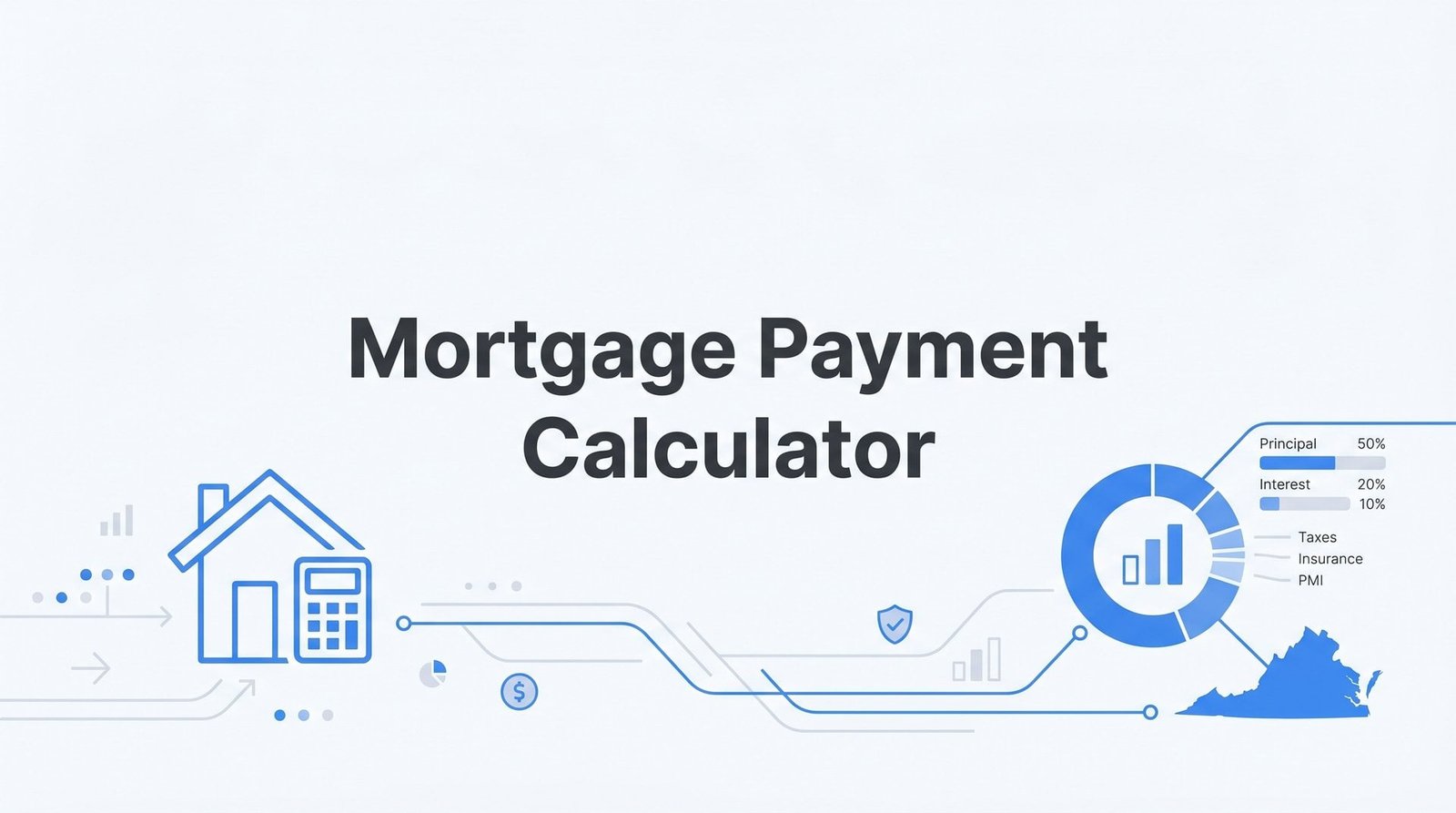
A payment number alone hides the real cost. Here is a worked illustration. The loan and rate are assumptions, not a quote: a $400,000 Henrico County, Virginia home, 10% down, a $360,000 loan at an illustrative 6.25% for 30 years.
- Principal and interest: about $2,217
- Property tax: the Henrico County real estate assessments page publishes the current rate per $100 of assessed value. For illustration only, I use $0.85 per $100: $400,000 ÷ 100 × $0.85 = $3,400 a year, or about $283 a month. Check the page for the current rate and assessment before you use this line (as of November 2026).
- Homeowners insurance: assumed $1,800 a year, or $150 a month. Get a real quote, and add flood coverage or HOA dues if they apply.
- PMI: assumed 0.5% of the loan annually, $1,800 or $150 a month.
- Total: about $2,800 a month.
PMI does not last forever. Your balance reaches 80% of the original value ($320,000) after roughly 92 payments, about 7.6 years on this schedule. You can request removal at that point if your payment history is good and the CFPB’s conditions are met. Under the Homeowners Protection Act, it terminates automatically when the balance is scheduled to reach 78% ($312,000), around payment 106. Details are in the CFPB’s PMI guidance. Removal drops this example to about $2,650 a month, a $150 monthly saving.
Now fill in the worksheet for each offer. Compare Offer A at 6.25% with no points against Offer B at 6.00% with 1.5 points ($5,400). Offer B saves about $58 a month. Over five years, that is roughly $3,500, which does not cover $5,400. Break-even is about 93 months, so the lower rate loses if you sell or refinance before then.
Step 7: Lock Your Rate and Protect It Through Closing
A rate lock holds your rate and points for a set period. Lock periods are commonly 30, 45, or 60 days, though you should verify what is offered for your scenario. Longer periods can price slightly higher. Read the CFPB’s rate lock explanation, then ask what the lock covers and what an extension costs if closing slips.
Floating is a bet on the market, and it can go either way. A practical rule: lock once the payment fits your budget on your worksheet. Ask whether a float-down or re-lock option exists, what it costs, and get all lock terms in writing.
Once locked, protect it:
- Do not change jobs or take on new credit before closing.
- Avoid large, unexplained deposits; underwriters will ask you to document them.
- Return requested documents quickly, because a fast close protects the lock.
To begin, start a soft-pull pre-approval with Duane Buziak at Better Mortgage Rates by Duane Buziak, available 24/7.
Ten Questions Borrowers Ask About Getting a Lower Mortgage Rate
What credit score do I need to get the lowest mortgage rate?
Higher scores generally price better, and pricing often steps at score tiers. No single score guarantees the best rate, because LTV, DTI, loan type, and occupancy also matter.
Does shopping for a mortgage hurt my credit score?
Not if you do it correctly. Start with a soft credit pull mortgage review, then keep hard-pull applications within a short window, since scoring models generally treat them as one inquiry.
Can I get a mortgage pre approval without a hard pull?
Yes. Duane Buziak offers a mortgage pre approval without hard pull through NoTouch Credit Pull, so you can see where you stand first.
What is the difference between mortgage rate and APR?
The rate determines your interest charge. APR also includes certain fees and points, which makes it better for comparing offers.
Is a lower rate always the cheaper loan?
No. A lower rate with points can cost more if you do not keep the loan past the break-even point.
How much does PMI actually cost me monthly?
It varies by credit, LTV, and loan amount. In the illustration above, an assumed 0.5% annual rate on $360,000 is $150 a month. Get a real quote.
When can I remove PMI?
You can request removal when your balance reaches 80% of the original value, and it ends automatically at 78% on schedule under the Homeowners Protection Act. Confirm details with the CFPB.
How long should I lock my mortgage rate?
Match the lock to your expected closing date plus a cushion. Periods are commonly 30, 45, or 60 days; confirm what is available.
Can anyone guarantee me a specific mortgage rate?
No. Rates are set after underwriting and change daily. Be wary of any guarantee made before your file is reviewed.
Is Better Mortgage Rates by Duane Buziak a legit mortgage broker?
Yes. Duane Buziak is licensed under NMLS #1110647, with Coast2Coast Mortgage LLC, NMLS #376205. You can verify both at the NMLS Consumer Access site.
Your Rate Checklist and What to Do With It This Week
You now have the sequence: understand the drivers, clean up credit, improve LTV and DTI, match the loan to your timeline, compare same-day Loan Estimates, fill in the worksheet, and lock. Before you act on any figure here, confirm current rates and local tax numbers at the sources cited, including Freddie Mac and the Henrico County page. The numbers in this guide are illustrations.
Ready to find your best mortgage rate from hundreds of lenders without impacting your credit score? Get your free no-touch pre-qualification today and discover exactly what you qualify for with personalized guidance from a trusted mortgage expert at Better Mortgage Rates by Duane Buziak.