
Buying a home in Virginia is one of the most exciting decisions you’ll ever make. Whether you’re eyeing a colonial in Short Pump, a townhome in Chesterfield, a craftsman in Midlothian, or a waterfront retreat on Lake Anna, the journey starts with one critical question: Can I actually qualify for a mortgage?
For many Virginia homebuyers, the qualification process feels like a black box. Big-name lenders like Rocket Mortgage and Freedom Mortgage make it seem like a simple online form — but the reality is far more nuanced. Your credit score, debt load, income documentation, and even which lender you choose all play a role in whether you get approved, at what rate, and on what terms.
Here’s something most people don’t realize: the lender you choose matters as much as the financial profile you bring to the table. Retail lenders like Movement Mortgage, Atlantic Bay Mortgage, and PrimeLending can only offer their own products. A mortgage broker, on the other hand, shops your application across hundreds of lenders simultaneously, which often means better rates, more flexible qualification guidelines, and programs tailored to your specific situation.
At Better Mortgage Rates, Duane Buziak — Mortgage Broker of the Year — helps homebuyers across Richmond, Henrico, Fredericksburg, Hampton Roads, Virginia Beach, Roanoke, Charlottesville, and beyond navigate this process with confidence. One of the biggest advantages? A free NoTouch Credit Solution that lets you explore your mortgage options without a hard credit inquiry touching your score.
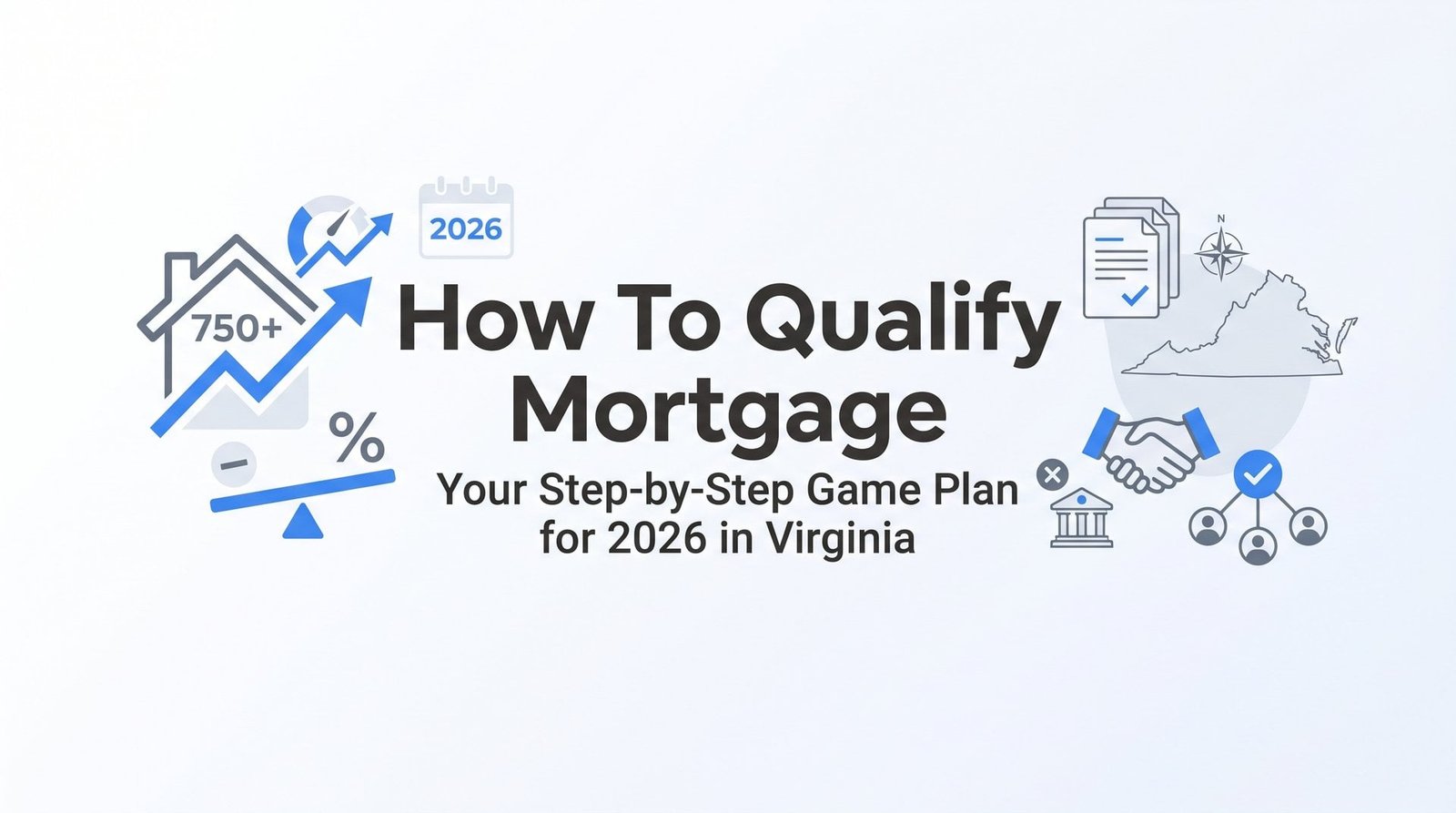
This guide walks you through the exact steps to qualify for a mortgage in Virginia in 2026. You’ll see direct comparisons with competitors like Alcova Mortgage, CapCenter, and Veterans United, understand what lenders actually look for, and learn how to position yourself for the best possible outcome. Let’s get into it.
Step 1: Check Your Credit Score — Without Hurting It
Your credit score is the first thing any lender evaluates. It signals how reliably you’ve managed debt in the past, and it directly influences whether you qualify and at what interest rate. Before you call a single lender, you need to know where you stand.
Here are the general credit score thresholds you’ll encounter in 2026:
Conventional Loans: Most lenders require a minimum score of 620, though scores of 740 and above typically unlock the most competitive rates.
FHA Loans: The Federal Housing Administration allows scores as low as 580 for a 3.5% down payment. Scores between 500 and 579 may still qualify with a 10% down payment, though fewer lenders participate at that threshold.
VA Loans: The VA itself sets no official minimum, but most lenders apply their own overlays, typically requiring scores around 580 to 620. This matters especially for buyers in Hampton Roads, Newport News, Chesapeake, and Virginia Beach, where VA loans are extremely common due to the region’s military community.
Now here’s where the competitor comparison gets important. When you inquire with most retail lenders — Rocket Mortgage, Guild Mortgage, Atlantic Bay Mortgage, Movement Mortgage — they typically run a hard credit pull almost immediately. That inquiry shows up on your credit report and can lower your score, sometimes before you even know whether you want to work with that lender. Understanding your options through a no credit check mortgage approach can protect your score during the early stages.
Q: Why doesn’t Better Mortgage Rates pull my credit upfront like Rocket Mortgage or Guild Mortgage?
Because you deserve to explore your options without risk to your score. Better Mortgage Rates uses a free NoTouch Credit Solution — a soft-pull approach that lets Duane Buziak review your credit profile and give you meaningful guidance without triggering a hard inquiry. You see where you stand first. You make an informed decision. Then, when you’re ready to move forward, the hard pull happens with purpose.
Before engaging any lender, take this actionable step: visit AnnualCreditReport.com and pull your free credit reports from all three bureaus — Equifax, Experian, and TransUnion. Review them carefully for errors, outdated accounts, or unfamiliar items. Disputing inaccuracies can improve your score meaningfully before you apply.
Success indicator: You know your approximate credit score range, you’ve reviewed your reports for errors, and you haven’t taken a single hard inquiry hit. That’s the right starting position.
Step 2: Calculate Your Debt-to-Income Ratio Like a Lender Would
Credit score gets you in the door. Your debt-to-income ratio (DTI) determines whether you can afford to walk through it. Lenders use DTI to measure how much of your gross monthly income goes toward debt payments — and it’s one of the most important qualification factors you need to understand.
There are two DTI calculations lenders look at:
Front-End DTI (Housing Ratio): This is your proposed monthly housing payment (principal, interest, taxes, and insurance) divided by your gross monthly income. Most conventional programs prefer this at or below 28-31%.
Back-End DTI (Total Debt Ratio): This adds all your monthly debt obligations — housing payment, car loans, student loans, credit card minimums, and other installment debts — divided by your gross monthly income. Most conventional programs cap this at 45-50% with strong compensating factors. FHA loans can sometimes allow up to 57% with automated underwriting approval.
Let’s make this practical. Imagine a buyer in Midlothian or Glen Allen earning $7,500 per month in gross income. They have a $400 car payment, $300 in student loan payments, and $150 in minimum credit card payments. That’s $850 in existing monthly debt. If they’re looking at a home with a $1,800 monthly housing payment, their back-end DTI would be ($850 + $1,800) / $7,500 = roughly 35%. That’s a comfortable position for most loan programs.
Student loans deserve special attention. How your student loan payments are counted in DTI calculations varies by loan type and lender. Some programs use the actual payment on an income-driven repayment plan. Others use a percentage of the outstanding balance regardless of your actual payment. This nuance can significantly affect your qualification, and it’s worth understanding before you apply.
Here’s where the broker advantage shows up again. Some retail lenders like C&F Mortgage Corporation or NFMLending may have rigid internal DTI caps that don’t flex much. When you work with Better Mortgage Rates, Duane Buziak can shop your profile across hundreds of lenders to find programs with more flexible thresholds — programs that might accommodate a higher DTI if you have strong compensating factors like significant reserves or a high credit score.
Before your pre-qualification conversation, use a mortgage payment calculator to estimate what your target home’s monthly payment would look like. Add that to your existing debts, divide by your gross monthly income, and you’ll have a working DTI estimate to bring to the conversation.
Success indicator: You’ve calculated your DTI, you know whether you’re in a comfortable qualification range, and you understand which loan programs your DTI profile aligns with.
Step 3: Gather Your Income and Employment Documentation
Knowing your numbers is one thing. Proving them to a lender is another. Mortgage qualification is a documentation-intensive process, and arriving prepared saves you time, reduces stress, and speeds up your approval timeline.
For most traditionally employed borrowers, here’s the standard document list you’ll need to compile:
1. W-2 forms from the past two years
2. Recent pay stubs covering the last 30 days
3. Federal tax returns (personal and business if applicable) from the past two years
4. Bank statements from the past two to three months for all accounts used for down payment and reserves
5. Photo ID and Social Security number for all borrowers
6. Documentation of any other income sources — rental income, alimony, investment distributions, etc.
Now, Virginia has a thriving community of self-employed professionals, freelancers, entrepreneurs, and business owners — particularly in Charlottesville, Roanoke, Williamsburg, and the growing corridors around Goochland and Louisa. If that’s you, traditional W-2 documentation doesn’t tell your full financial story. And this is where retail lenders often fall short.
Q: What if I’m self-employed and my tax returns don’t reflect my actual income?
This is one of the most common challenges self-employed borrowers face. Tax returns often show reduced income after legitimate business deductions — which is smart tax strategy but can complicate mortgage qualification. Retail lenders like PrimeLending or Fairway Independent Mortgage typically offer only their own product lineup, which may not include flexible income documentation options. Many self-employed buyers benefit from exploring a mortgage without tax returns as an alternative path to approval.
As a mortgage broker, Better Mortgage Rates has access to lenders offering bank statement loan programs (where 12-24 months of bank deposits are used to calculate income instead of tax returns), asset-based qualification programs, and other non-traditional documentation pathways. These programs exist specifically for borrowers whose financial strength isn’t captured in a standard tax return.
One critical warning applies to every borrower, regardless of employment type: do not change jobs, make large unexplained deposits, open new credit accounts, or make significant financial moves during the qualification and closing process without first consulting your mortgage professional. These changes can trigger additional underwriting scrutiny or even derail an approval that was already in progress.
Success indicator: You have a complete, organized document folder ready to submit — and if you’re self-employed, you’ve already discussed alternative income documentation options with your mortgage broker.
Step 4: Get Pre-Qualified (Then Pre-Approved) With the Right Partner
At this point, you understand your credit position, your DTI, and your documentation needs. The next move is getting into the market with a pre-qualification or pre-approval in hand. But these two terms are not interchangeable, and knowing the difference matters.
Pre-Qualification is an initial estimate based on self-reported financial information. It gives you a general sense of what you might qualify for, but it’s not verified. It’s useful for early-stage planning and understanding your ballpark budget. You can learn more about the mortgage pre-qualification process and how it differs from pre-approval.
Pre-Approval is a more rigorous process where a lender verifies your income, assets, employment, and credit. A pre-approval letter carries real weight because it signals to sellers that you’re a serious, financially vetted buyer.
In competitive Virginia markets — Short Pump, Hanover, Spotsylvania, Stafford, and Prince William — sellers regularly receive multiple offers. A pre-approved buyer has a meaningful edge over someone who’s only pre-qualified. In some situations, sellers won’t even consider offers without a pre-approval letter attached.
Q: Should I get pre-approved directly with Rocket Mortgage, Veterans United, or CrossCountry Mortgage?
You could — but here’s what you’d be giving up. Each of those lenders can only approve you for their own products, at their own rates, using their own guidelines. If their rate isn’t competitive or their guidelines don’t fit your profile, you’re starting over with a new lender and potentially another hard credit inquiry.
When you pre-qualify with Better Mortgage Rates, Duane Buziak evaluates your complete financial profile and shops it across hundreds of lenders simultaneously. You’re not getting one option. You’re getting the best option from a wide competitive field — the program and rate that actually fits your situation. And because of the NoTouch Credit Solution, the initial pre-qualification process starts with zero credit impact. Effective mortgage rate comparison across multiple lenders is exactly what a broker provides that a single retail lender cannot.
The process works like this: you share your financial information, Duane reviews your profile using a soft credit pull, identifies the strongest lender matches for your situation, and then guides you through a full pre-approval with the lender best positioned to serve you. By the time you’re writing offers in Richmond, Fredericksburg, or Virginia Beach, you have a solid pre-approval letter and a clear understanding of your buying power.
This is also the right time to explore specific mortgage programs. Are you a veteran eligible for a VA loan? A first-time buyer considering FHA? A move-up buyer targeting a conventional loan? Your pre-qualification conversation should clarify which path makes the most sense before you invest time in documentation.
Success indicator: You hold a pre-approval letter that makes you a competitive, credible buyer in your target Virginia market — and you got there without unnecessary credit inquiries or wasted time shopping single-lender options.
Step 5: Understand Your Loan Options and Choose the Best Fit
Not all mortgages are created equal, and the loan type you choose affects your qualification requirements, your down payment, your monthly payment, and your long-term costs. Here’s a clear breakdown of the primary loan programs available to Virginia buyers in 2026.
Conventional Loans: Backed by Fannie Mae or Freddie Mac, these are the most common loan type. They require a minimum 620 credit score and typically a 3% to 20% down payment. Private mortgage insurance (PMI) applies if you put down less than 20%, but a broker can often find lender-paid MI options that reduce or eliminate this cost. For a deeper dive into the differences, our guide on FHA vs conventional loans breaks down the key considerations for Virginia buyers.
FHA Loans: Insured by the Federal Housing Administration, FHA loans are accessible to buyers with lower credit scores and smaller down payments (as low as 3.5%). They carry mortgage insurance premiums for the life of the loan in most cases, but they open doors for buyers who don’t yet qualify for conventional programs.
VA Loans: Available to eligible veterans, active-duty service members, and surviving spouses, VA loans require no down payment and no private mortgage insurance. They’re one of the most powerful financial tools available to military families — and they’re enormously popular in Hampton Roads, Newport News, Suffolk, Chesapeake, and Virginia Beach, given the region’s significant military presence.
On VA loans specifically, it’s worth addressing Veterans United directly. Veterans United is a large retail lender that specializes in VA loans — but they only offer their own products. Better Mortgage Rates works with multiple lender partners who offer VA loan programs, which means Duane Buziak can compare VA loan options across lenders to find the most competitive rate and terms for your specific situation rather than being limited to one company’s offering.
Jumbo Loans: For properties that exceed conventional conforming loan limits, jumbo loans apply stricter qualification requirements — typically higher credit scores and larger down payments. Buyers targeting higher-priced properties in Albemarle, Goochland, or waterfront communities on Lake Anna may encounter jumbo territory.
Now for the competitor landscape on product selection:
Q: What about CapCenter, which advertises no lender fees?
CapCenter’s fee structure is worth understanding, but “no lender fees” doesn’t automatically mean the lowest total cost. Rate, loan program selection, and long-term costs all factor into the true value of your mortgage. CapCenter offers their own limited product lineup. Better Mortgage Rates competes on total value — rate, program fit, and service — across hundreds of lenders.
Southern Trust Mortgage and River City Lending serve specific niches in the Virginia market. Prosperity Mortgage and RatePro Mortgage have regional footprints with product limitations. When your loan is being shopped across hundreds of wholesale lenders simultaneously, you’re not limited by any single lender’s product shelf. You can explore the full range of available loan programs to find the right fit.
For buyers in growing areas like Goochland, Louisa, and Caroline County where new construction is active, construction-to-permanent loan programs are also worth exploring. These programs combine the construction financing and permanent mortgage into a single loan, simplifying the process for buyers building a new home.
Success indicator: You’ve identified the loan type that aligns with your financial profile, your homebuying goals, and the specific Virginia market you’re targeting.
Step 6: Strengthen Any Weak Spots Before Final Submission
Most buyers don’t arrive at the mortgage process in perfect financial shape. That’s not a problem — it’s an opportunity. Identifying and addressing weak spots before you submit your final application can be the difference between a denial and an approval, or between a good rate and a great one.
If your credit needs work: Better Mortgage Rates offers credit restoration services as a free resource — something most direct lenders like Penny Mac, Freedom Mortgage, or Embrace Home Loans simply don’t provide. Rather than telling you to come back when your score improves, Duane Buziak can help you build a concrete credit improvement plan and monitor your progress toward qualification. This might mean disputing errors, paying down specific accounts strategically, or understanding which actions will have the fastest positive impact on your score.
If your DTI is too high: The most direct fix is paying down revolving debt — credit cards in particular have a strong impact on both your DTI and your credit utilization ratio. Avoid opening new credit lines during this period. In some cases, adding a creditworthy co-borrower can strengthen your application by increasing qualifying income. Your mortgage broker can help you model which approach makes the most sense for your specific numbers.
If your down payment is short: You have more options than you might think. Conventional programs allow as little as 3% down. FHA requires just 3.5% for eligible borrowers. VA loans require zero down payment for eligible veterans and service members. For those just entering the market, exploring first home buyer assistance programs can uncover down payment grants and other resources available to Virginia buyers.
Virginia-specific consideration: property taxes vary significantly by locality, and this directly affects your qualification math because taxes are factored into your monthly housing payment for DTI purposes. Henrico County, Stafford County, Prince William County, and the City of Lynchburg all have different tax rates. When you’re calculating what you can afford, make sure you’re using the actual property tax rate for the specific locality where you’re buying — not a generic estimate.
One final warning that applies to every stage of this process: do not open new credit accounts, make large unexplained purchases, co-sign any loans, or make significant financial changes between pre-approval and closing. Underwriters verify your financial profile right up to closing day, and changes during this window can jeopardize your approval.
Success indicator: You’ve identified any qualification gaps, you have a clear plan to address them, and you feel genuinely confident moving into the final submission stage.
Your 2026 Mortgage Qualification Checklist: Putting It All Together
You now have a complete picture of what mortgage qualification actually involves in Virginia. Before you take your next step, here’s your quick-reference checklist to make sure you’ve covered every base.
Step 1 — Credit: Pull your free reports from AnnualCreditReport.com, review for errors, and get a soft-pull credit review through Better Mortgage Rates’ NoTouch Credit Solution. No hard inquiry, no score impact.
Step 2 — DTI: Calculate your front-end and back-end debt-to-income ratios. Know your numbers before any lender conversation begins.
Step 3 — Documentation: Assemble your W-2s, pay stubs, tax returns, and bank statements. If you’re self-employed, ask about bank statement and alternative documentation programs.
Step 4 — Pre-Approval: Work with a mortgage broker who shops your profile across hundreds of lenders — not a single retail lender offering only their own products.
Step 5 — Loan Selection: Identify the right loan program for your financial profile, whether that’s conventional, FHA, VA, jumbo, or a specialty product for your situation.
Step 6 — Gap Closing: Address any weak spots in credit, DTI, or down payment before final submission. Take advantage of credit restoration support if needed.
Here’s the bottom line on lender choice. Rocket Mortgage, Alcova Mortgage, Guild Mortgage, UWM, and other retail lenders all offer one thing: their own products. That’s not necessarily bad, but it limits your options by definition. When Duane Buziak at Better Mortgage Rates — Mortgage Broker of the Year — works on your behalf, he’s shopping your application across hundreds of lenders to find the rate, program, and terms that actually fit your life. And it all starts with a free NoTouch Credit Solution that protects your score from the very first conversation.
Whether you’re buying in Richmond, Fredericksburg, Virginia Beach, Roanoke, Albemarle, Williamsburg, or anywhere across Virginia, Florida, Tennessee, or Georgia, the qualification steps are the same. The partner you choose determines the options you’ll see and the rate you’ll pay.
Ready to find out exactly where you stand? Start your free, no-credit-hit pre-qualification with Better Mortgage Rates today and let Duane Buziak show you what hundreds of lenders competing for your business actually looks like. Learn more about our mortgage services and take the first step toward your Virginia home with confidence.