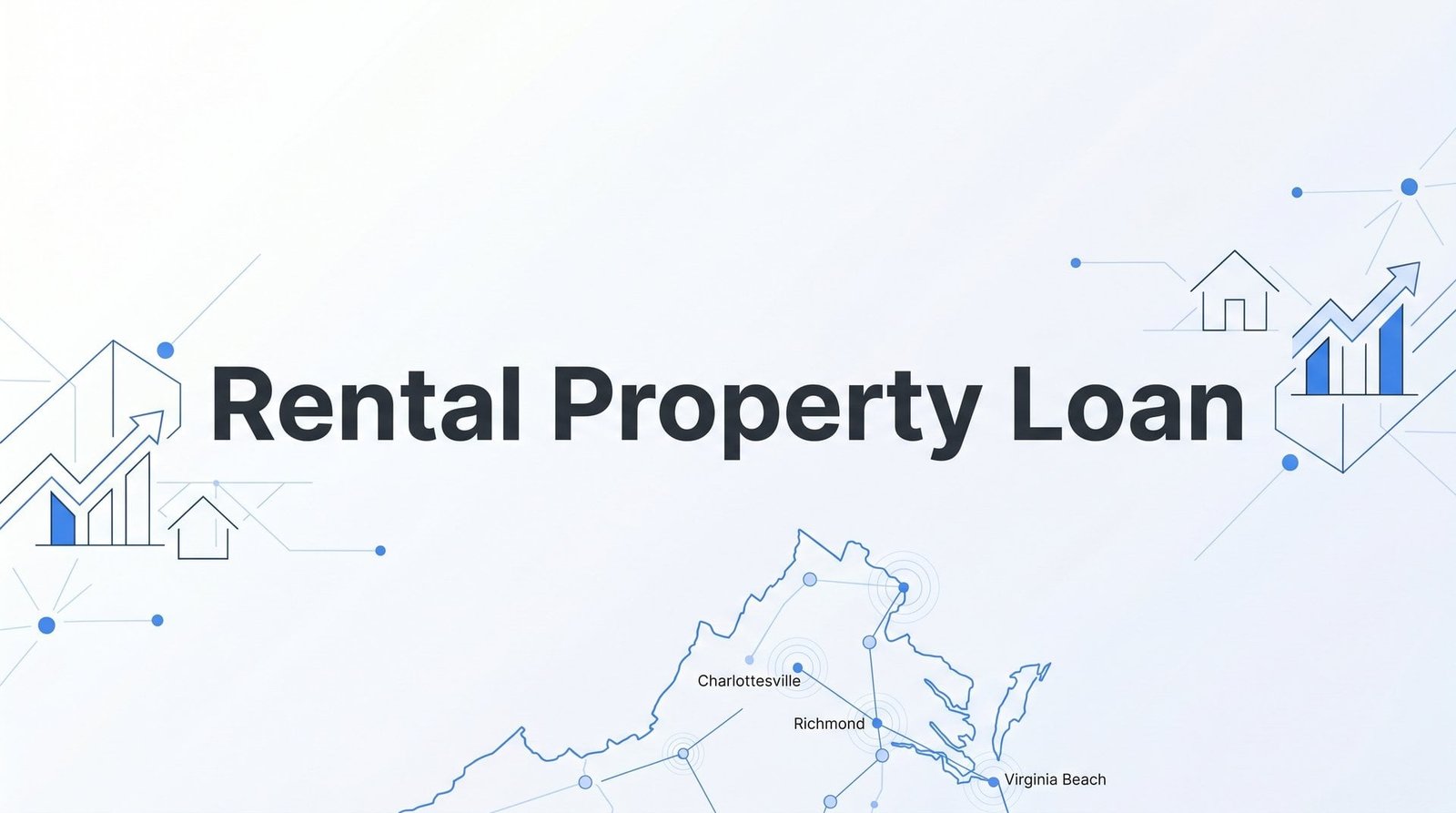

Virginia’s rental property market is presenting real opportunities for investors who know how to move. From the expanding Richmond metro corridor through Short Pump and Glen Allen, to the military-driven rental demand in Virginia Beach, Chesapeake, and Newport News, to the steady college-town markets in Charlottesville and Williamsburg — the conditions for building a rental portfolio across the Commonwealth are compelling. And yet, for many investors, the financing side of the equation creates more confusion than the property search itself.
Here’s the reality: a rental property loan works very differently from the mortgage you used to buy your home. The down payment requirements are higher, the qualification standards are stricter, and the rate structure reflects the additional risk lenders associate with investment properties. If you walk into this process expecting a primary residence experience, you’ll hit walls quickly.
That’s where working with the right mortgage partner changes everything. Better Mortgage Rates, led by Duane Buziak, has earned recognition as Mortgage Broker of the Year — and for good reason. With access to hundreds of lenders and a free NoTouch Credit pre-qualification process that carries zero credit impact, Better Mortgage Rates gives Virginia investors the ability to explore their options intelligently, without the risk of a hard credit pull just to get a number. Throughout this guide, we’ll break down exactly how rental property loans work, what you need to qualify across Virginia’s key markets, and why working with an independent broker delivers advantages that big-name retail lenders simply cannot match.
The Structural Difference: Investment Loans vs. Primary Residence Mortgages
Let’s start with the fundamentals, because this is where a lot of first-time rental investors get caught off guard. When a lender evaluates a loan for your primary residence, they know you’re highly motivated to keep that property. Investment properties carry a different risk profile. If financial pressure mounts, borrowers are statistically more likely to prioritize their home payment over a rental property. Lenders price that risk into the terms.
What that means practically: rental property loans typically require down payments in the range of 15% to 25%, compared to as little as 3-5% for primary residence loans. Interest rates are generally higher as well, reflecting the elevated risk tier. And lenders will want to see meaningful cash reserves, often six months or more of mortgage payments, sitting in your accounts after closing. Understanding the differences between FHA vs conventional loans can help clarify why investment property financing operates under a separate set of rules.
For Virginia investors, the good news is that multiple loan types exist to serve different investor profiles and property situations.
Conventional Investment Property Loans: These follow Fannie Mae and Freddie Mac guidelines and are the most common path for investors with strong W-2 income and solid credit. They work well for properties in established markets like Chesterfield, Henrico, or Virginia Beach where appraisals are straightforward and rental comps are easy to document.
DSCR Loans (Debt Service Coverage Ratio): This loan type has become increasingly popular among rental investors because qualification is based on the property’s rental income potential rather than your personal income. If the rent the property generates covers the mortgage payment (typically at a 1.0 or better ratio), you can qualify — even without tax returns or pay stubs. This is a powerful option for self-employed investors or those with complex income situations eyeing properties in markets like Midlothian, Goochland, or Hanover.
Portfolio Loans: These are held by lenders on their own books rather than sold to secondary markets, which gives them more flexibility on terms and qualification criteria. Portfolio loans are particularly useful for investors buying in smaller or more rural markets, or those already carrying multiple financed properties.
One important clarification that saves Virginia investors significant time: FHA loans and VA loans are generally not available for pure investment properties. There are narrow exceptions involving owner-occupancy, but if your plan is to purchase a property as a rental from day one, these programs are not the right path. Investors interested in fix and flip loan strategies should also understand that those programs serve a fundamentally different investment timeline than long-term rental financing.
Qualifying for a Rental Property Loan Across Virginia’s Key Markets
Qualification requirements for rental property loans are more rigorous than primary residence standards, but they’re absolutely achievable with the right preparation and the right lender access. Here’s what you’re typically working with.
Credit score requirements generally start at 620 for some programs, but the most competitive rental property loan rates typically require scores of 680 or higher. The higher your score, the better the rate tier you’ll access — and on an investment property loan, that difference compounds significantly over the life of the loan. If your score needs work, reviewing strategies to improve mortgage approval odds before applying can make a meaningful difference in the terms you receive.
Debt-to-income ratio (DTI) matters as well. Lenders want to see that your total debt obligations, including the new rental property mortgage, remain within manageable limits relative to your income. For conventional investment property loans, DTI limits are typically stricter than on primary residence loans. This is where DSCR loans offer a genuine alternative: because they qualify on property income rather than personal DTI, they can open doors that conventional programs close.
Cash reserves are non-negotiable. Most lenders want to see six months of mortgage payments in reserve after your down payment clears. For investors purchasing in higher-value markets like Virginia Beach or Charlottesville’s Albemarle County, that reserve requirement translates to a meaningful dollar amount, so planning ahead matters.
Virginia’s regional markets each carry their own investment dynamics worth understanding as you plan your strategy.
Richmond Metro (Richmond, Short Pump, Glen Allen, Henrico, Chesterfield, Midlothian): Consistent population growth and a diversifying job base have created steady rental demand across this corridor. Single-family rentals and small multifamily properties in these submarkets tend to attract stable, long-term tenants.
Hampton Roads (Virginia Beach, Chesapeake, Newport News, Suffolk, Yorktown): Military presence creates a uniquely durable rental market. Service members and their families represent a reliable tenant pool, and the region’s diverse employment base beyond the military adds additional stability.
Fredericksburg to Prince William Corridor (Fredericksburg, Spotsylvania, Stafford, Prince William): Commuter-driven demand keeps this corridor active. Investors who understand the tenant profile here — families and professionals seeking more space than urban centers offer — can build strong portfolios.
College and Destination Markets (Charlottesville, Williamsburg, Ashland, Lake Anna, Louisa): Student housing demand in Charlottesville and Williamsburg creates consistent rental cycles. Lake Anna and Louisa attract a different profile: vacation and short-term rental investors who may benefit particularly from DSCR loan structures.
Hanover, Goochland, and Caroline County: Growing suburban and semi-rural markets where investors can often find better value per door while still serving tenants priced out of closer-in Richmond suburbs.
For self-employed investors or those with income that doesn’t show cleanly on tax returns, DSCR loans and bank statement programs are especially relevant. These programs evaluate the property’s income potential and your overall financial picture without requiring traditional income documentation — a significant advantage explored in depth in our guide to self-employed mortgage options in Virginia.
Better Mortgage Rates vs. Rocket Mortgage, Freedom Mortgage, and the Big-Name Lenders
This is the comparison that matters most for Virginia investors making a financing decision. Let’s be direct about what the differences actually are.
Rocket Mortgage, Freedom Mortgage, PrimeLending, and Penny Mac are retail lenders. That means they can only offer you their own products. When you apply with them, you’re getting a quote from one lender’s menu. If their investment property programs don’t fit your situation, they don’t have another option to offer you. You either fit their box or you don’t. Taking the time to do a thorough mortgage rate comparison across multiple lenders is one of the most impactful steps an investor can take.
Better Mortgage Rates operates as an independent mortgage broker. That means Duane Buziak shops your loan across hundreds of wholesale lenders to find the best available terms for your specific investment profile. If one lender’s DSCR program isn’t the right fit, there are dozens of others to evaluate. If your credit profile, reserve situation, or property type requires a specialized program, a broker network has the depth to find it. A single retail lender does not.
The credit inquiry issue deserves its own conversation. Many lenders, including CrossCountry Mortgage, Guild Mortgage, and Atlantic Bay Mortgage, require a hard credit pull just to generate a rate quote. That hard inquiry temporarily lowers your credit score, which matters when you’re in the middle of evaluating multiple properties and want to understand your options before committing. Better Mortgage Rates’ free NoTouch Credit pre-qualification uses a soft pull, meaning zero impact on your credit score. Investors curious about alternatives can also explore no credit check mortgage options to understand the full landscape of credit-friendly qualification paths.
For investors considering local Virginia lenders, the picture is similar. CapCenter, Alcova Mortgage, Prosperity Mortgage, RatePro Mortgage, Southern Trust Mortgage, and River City Lending are all retail operations with their own product sets. They may serve primary residence borrowers well, but their investment property loan menus are limited by definition. As Mortgage Broker of the Year, Duane Buziak can access specialized investment property programs including DSCR loans, portfolio products, and multi-property financing structures that many Virginia-based retail lenders simply don’t carry.
C&F Mortgage Corporation, NFMLending, Embrace Home Loans, and Veterans United are similar stories. Veterans United in particular is heavily focused on VA loans, which as noted earlier, are generally not available for pure investment properties. If you go there looking for a rental property loan, you’re likely to be redirected or offered limited alternatives.
Movement Mortgage and Fairway Independent Mortgage are larger operations with broader product sets, but they still operate as retail lenders. You’re getting their products, their pricing, and their service model — which typically means a more transactional experience rather than the kind of personalized investor-focused guidance that comes from working directly with Duane Buziak.
Q&A: The Questions Every Virginia Rental Investor Should Ask
The best way to cut through the noise on rental property financing is to ask the right questions directly. Here are the ones that matter most for Virginia investors.
Can I get a rental property loan without showing tax returns? Yes. DSCR loans and certain no-doc programs qualify borrowers based on the property’s rental income potential rather than personal income documentation. This is particularly valuable for self-employed investors or those whose tax returns show significant deductions that don’t reflect their actual financial strength. Our detailed guide on getting a mortgage without tax returns walks through the specific programs and requirements in Virginia.
Do I need 25% down for every investment property? Not necessarily. While 25% down is a common benchmark for conventional investment property loans, some programs allow 15-20% down depending on your credit profile, the property type, and the specific lender program. Starting with a NoTouch Credit pre-qualification gives you a clear picture of what down payment thresholds apply to your specific situation before you start making offers.
What if I already own multiple financed properties? Conventional guidelines have limits on the number of financed properties a borrower can hold, but portfolio loans and blanket loan programs available through broker networks can accommodate investors scaling beyond those limits. Investors looking at duplexes, triplexes, or fourplexes should also review our guide to multi-family loan financing for Virginia-specific program details.
Why choose Better Mortgage Rates over Movement Mortgage or Fairway Independent Mortgage for my rental property loan? The answer comes down to three things: lender access, credit protection, and personalized expertise. Movement Mortgage and Fairway are retail lenders with their own product sets and call-center service models. Better Mortgage Rates shops hundreds of lenders, protects your credit with a soft-pull pre-qualification, and gives you direct access to Duane Buziak’s expertise as Mortgage Broker of the Year. That combination is not available at a retail lender.
Are rental property loan rates different in Roanoke vs. Virginia Beach? The property’s location can influence certain program eligibility and appraisal dynamics, but your rate is primarily driven by your credit profile, down payment, loan type, and the lender program you qualify for. Better Mortgage Rates serves investors across all Virginia markets — from Roanoke and Lynchburg to Virginia Beach, Hampton Roads, and the entire Richmond metro.
Can I finance a rental in Lynchburg, Lake Anna, or Louisa County? Absolutely. Better Mortgage Rates covers all of Virginia’s target markets, including Lynchburg, Lake Anna, Louisa, Ashland, Caroline County, Albemarle, Yorktown, Suffolk, and every market in between. Statewide coverage means your investment opportunity isn’t limited by your lender’s geographic footprint.
What about rental properties in Florida, Tennessee, or Georgia? Better Mortgage Rates also serves investors in Florida, Tennessee, and Georgia — so if your investment strategy extends beyond Virginia, the same lender access, NoTouch Credit pre-qualification, and personalized guidance applies across all four states.
Positioning Yourself for the Best Possible Loan Terms
Getting the best rental property loan terms isn’t just about finding the right lender. It’s also about showing up to the conversation as a well-prepared borrower. Here are the moves that matter most before you apply.
Build your cash reserves intentionally. Lenders want to see reserves after closing, not just enough to cover the down payment. If you’re targeting a property in Spotsylvania or a duplex in Richmond, map out what six months of mortgage payments looks like in dollar terms and make sure that amount is sitting in a clearly documented account before you apply. Using a mortgage payment calculator can help you project those numbers accurately across different property price points.
Understand your existing debt picture. Your current mortgage obligations, car payments, and other debts all factor into your DTI calculation for a conventional investment property loan. Review your full debt picture before applying so you’re not surprised by how it affects your qualification range. If your DTI is a concern, a DSCR loan may be the right path forward.
Get rental comps for your target property. Whether you’re eyeing a single-family rental in Fredericksburg or a small multifamily in Henrico, having documented rental income projections strengthens your application — and is essential for DSCR loan qualification. A local property manager or real estate agent can provide comparable rental data that supports your case.
Start with a free NoTouch Credit pre-qualification. This is genuinely the smartest first step for any Virginia rental investor. Before you make an offer, before you commit to a property, before you start comparing rates — know exactly where you stand. Better Mortgage Rates’ soft-pull pre-qualification gives you a clear picture of your qualification range, the loan programs available to you, and the rate tiers you’re looking at, all without touching your credit score. Compare that to the hard-pull process at C&F Mortgage Corporation or Veterans United, where just getting a quote costs you credit score points. Our guide on how to prepare for your mortgage consultation walks through exactly what to have ready for that first conversation.
Think about your multi-property strategy from the start. If your goal is to build a portfolio of rental properties over time rather than just acquire one, that changes how you approach financing from day one. Investors scaling from one rental to multiple properties need access to programs that can accommodate growing portfolio complexity. Better Mortgage Rates’ network of hundreds of lenders includes portfolio lenders, blanket loan programs, and DSCR products designed specifically for investors who think beyond the first property — a capability that single-lender retail options from competitors simply cannot replicate.
Your Next Steps as a Virginia Rental Investor
The right rental property loan doesn’t come from walking into the first lender you find or filling out a form on Rocket Mortgage’s website. It comes from working with someone who has access to the full market, understands the nuances of investment property financing, and can match your specific situation to the right program among hundreds of options.
Better Mortgage Rates brings all of that to Virginia investors. Hundreds of lenders. Mortgage Broker of the Year expertise from Duane Buziak. Free NoTouch Credit pre-qualification with zero credit impact. And deep, market-specific knowledge across every Virginia region you’re considering, from the Richmond metro’s Short Pump and Glen Allen corridors to Hampton Roads’ military-driven markets, from Charlottesville’s college-town dynamics to the growing communities of Hanover, Goochland, Lake Anna, and beyond.
Whether you’re financing your first rental property in Chesterfield or scaling a portfolio across Virginia, Florida, Tennessee, or Georgia, the conversation starts the same way: with a free, no-obligation consultation that gives you real answers without any risk to your credit.
Ready to explore your rental property loan options? Contact Duane Buziak at Better Mortgage Rates today to learn more about our services and start your free NoTouch Credit pre-qualification. Know what you qualify for, understand your options across hundreds of lenders, and move forward on your next investment with confidence.