
Updated September 2026 — Live Rates available now at BetterMortgageRates.com.
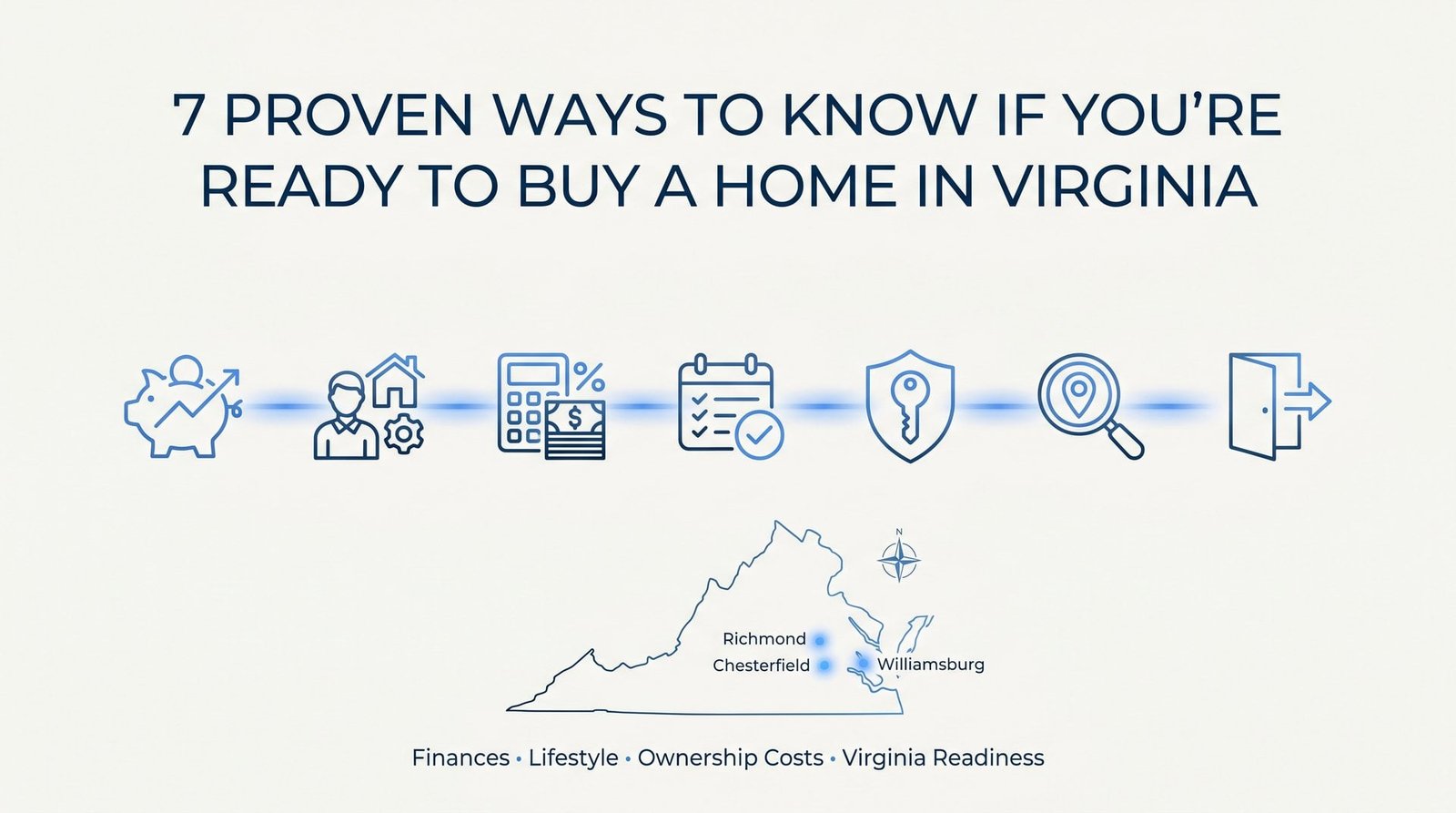
Knowing whether you’re ready to buy a home in Virginia means running seven concrete checkpoints — covering your debt-to-income ratio, savings, credit score, true monthly budget, life stability, lender comparison, and pre-qualification status. Buyers who work through all seven consistently close with confidence in 60–90 days; those who skip the prep phase often spend 12–18 months in uncertainty.
Whether you’re eyeing a colonial in Richmond’s Fan District, a new build in Chesterfield, or a townhome near Williamsburg, readiness goes far beyond simply wanting a place of your own. It involves your finances, your lifestyle stability, and a clear-eyed understanding of what homeownership truly costs every single month. The good news: readiness isn’t a feeling. It’s a set of measurable checkpoints you can evaluate right now.
This guide walks you through all seven checkpoints with specific numbers to run, questions to ask yourself, and action steps you can start today. By the end, you’ll have a clear picture of where you stand — and what to do next, whether that’s making an offer or building toward readiness over the next six to twelve months.
Here’s something that changes the entire calculus for many buyers: the first step doesn’t have to cost you anything — not even a credit inquiry. The NoTouch Credit Pull available through Better Mortgage Rates lets you get pre-approved and shop current mortgage rates with no hard inquiry mortgage pre approval — your score stays completely intact. This soft credit pull mortgage process gives you real numbers on your qualifying range, program eligibility, and payment estimates. Some call it a mortgage pre approval without hard pull; others ask for a soft pull mortgage broker consultation or a no credit hit mortgage application. Whatever you call it, the result is the same: you replace uncertainty with data, and you do it without any downside.
For current mortgage rates — never rely on static figures in an article. Check our Live Rates page for today’s best available pricing across hundreds of wholesale lenders.
Author: Duane Buziak, Mortgage Maestro, NMLS #1110647 | Coast2Coast Mortgage LLC NMLS #376205
VA Broker of the Year 2024 & 2025 | Scotsman Guide Top Originator 2025 ($44.4M) & 2026 ($51.2M) | UWM PRO ELITE 2025 | Top 1% Nationwide
1. Run the Debt-to-Income Reality Check
The Challenge It Solves
Most buyers focus on whether they can afford a monthly payment. Lenders focus on something different: the ratio of your total monthly debt obligations to your gross monthly income. If you’ve never calculated your debt-to-income (DTI) ratio, you may be surprised by what the numbers reveal — in either direction.
The Strategy Explained
Your DTI has two components. The front-end ratio measures your proposed housing payment (principal, interest, taxes, insurance, and HOA if applicable) as a percentage of gross monthly income. The back-end ratio adds all monthly debt obligations — car payments, student loans, credit cards, and the proposed mortgage — to that same income figure.
Per the Fannie Mae Selling Guide, conventional loans typically use a 28% front-end guideline and a 43% back-end maximum, though automated underwriting can approve higher ratios in some cases. FHA loans, per HUD’s Single Family Housing Policy Handbook (HUD 4000.1), can allow back-end DTI up to 57% with compensating factors. VA loans use a residual income model rather than a strict DTI cap, which is one reason VA financing can be more flexible for qualifying veterans. You can learn more about how these programs differ in our guide on FHA vs conventional loans.
Implementation Steps
1. Add up all monthly minimum debt payments: car loans, student loans, credit card minimums, personal loans, and any other recurring obligations.
2. Divide that total by your gross monthly income (before taxes). Multiply by 100. That’s your current back-end DTI without any mortgage.
3. Estimate your target monthly housing payment (we’ll build this out in Strategy 4), add it to your existing debts, and divide again by gross income. If you’re under 43%, you’re in conventional range. If you’re between 43% and 50%, FHA may be worth exploring. If you’re over 50%, focus on debt paydown before applying.
Pro Tips
If your DTI is borderline, paying off a car loan or small personal loan before applying can shift your ratio meaningfully. Even eliminating one $300/month payment can change your qualifying loan amount. A mortgage professional can run a credit scenario showing exactly which debts, if eliminated, would have the greatest impact on your qualifying power.
2. Stress-Test Your Savings Beyond the Down Payment
The Challenge It Solves
Many buyers save diligently toward a down payment and then arrive at closing surprised by how many other costs are waiting. Closing costs, prepaid items, cash reserves, and immediate move-in expenses can add thousands of dollars to what you need on hand. Knowing the full cash picture before you start shopping prevents a painful last-minute scramble.
The Strategy Explained
Think of your home purchase cash needs in four buckets: down payment, closing costs, reserves, and move-in costs. Each one is real, and each one draws from the same pool of savings.
Down payment requirements vary by loan type. Conventional loans can go as low as 3% for first-time buyers (Fannie Mae HomeReady and Freddie Mac Home Possible programs). FHA requires 3.5% with a 580+ credit score. VA and USDA loans offer zero down options for qualifying borrowers. On a $400,000 home in Henrico County, a 5% conventional down payment equals $20,000. For a deeper look at minimal upfront options, explore our guide on low down payment mortgage strategies.
Closing costs in Virginia typically run 2% to 5% of the purchase price. Virginia’s grantor tax is set at $1 per $500 of sale price under Code of Virginia § 58.1-801, a verifiable state-level cost. Lender fees, title insurance, attorney fees, prepaid interest, and escrow setup add up quickly. On that same $400,000 purchase, budget $8,000 to $16,000 for closing costs depending on your loan type and negotiated seller concessions.
Reserves are the funds left over after closing. Many loan programs require two to six months of housing payments in verifiable accounts after your transaction closes. And move-in costs, appliances, repairs, and immediate maintenance needs are real expenses that catch first-time buyers off guard.
Implementation Steps
1. Calculate your target down payment based on the loan program you’re considering (3%, 3.5%, 5%, 10%, or 20%).
2. Add an estimated 3% of purchase price for closing costs as a conservative baseline, then ask a mortgage professional for a Loan Estimate to get a more precise figure for your scenario.
3. Add two months of your projected PITI payment as a reserve buffer, even if your loan program doesn’t strictly require it.
4. Add $2,000 to $5,000 as a move-in and immediate repair fund. Compare this total to your current liquid savings.
Pro Tips
Seller concessions can offset closing costs in many Virginia markets. In a balanced or buyer-friendly market, asking for 2% to 3% in seller-paid closing costs is common. For detailed strategies on reducing these expenses, see our article on mortgage closing costs in Virginia.
3. Check Your Credit Score Without the Anxiety
The Challenge It Solves
Credit score anxiety stops many qualified buyers from even starting the mortgage process. They worry that checking their credit will hurt their score, or they assume their score isn’t good enough without actually knowing the number. Both concerns are addressable, and neither should keep you from getting accurate information.
The Strategy Explained
There are two types of credit inquiries: hard pulls and soft pulls. A hard pull, the kind lenders use during formal application, does appear on your credit report and can temporarily affect your score. A soft pull does not affect your score at all and gives you the same information.
At Better Mortgage Rates, the NoTouch Credit pre-qualification uses a soft pull approach, giving you real score data and loan program eligibility without any credit impact. This means you can explore your options, understand your qualification range, and plan your next steps without committing to a formal application or triggering any credit consequences.
Here’s what your credit score range means in practical terms for Virginia homebuyers:
760 and above: Best available conventional rates. Access to all standard loan programs with the most favorable pricing.
720 to 759: Strong conventional qualification. Slight pricing adjustments compared to the top tier, but still highly competitive.
680 to 719: Solid conventional range. Some loan-level price adjustments (LLPAs) apply, making FHA worth comparing for cost efficiency.
640 to 679: FHA and VA are often the most cost-effective programs. Conventional is possible but pricing adjustments increase.
580 to 639: FHA minimum threshold for 3.5% down. VA has no published minimum score but most lenders apply overlays around 580 to 620.
Below 580: Focus on credit repair strategies before applying. This is a 6 to 12 month preparation window, not a permanent barrier.
Implementation Steps
1. Request a soft-pull pre-qualification to get your actual mortgage credit score, which differs from consumer scores shown on free apps like Credit Karma. Our detailed guide on credit score for mortgage qualification breaks down exactly what lenders look for.
2. Review your credit report for errors using AnnualCreditReport.com, the only federally authorized free credit report source.
3. If your score needs improvement, focus on the two highest-impact factors: payment history (pay everything on time, every time) and credit utilization (keep balances below 30% of each card limit, ideally below 10%).
Pro Tips
Mortgage credit scores use older FICO models (FICO 2, 4, and 5 from the three bureaus) rather than the newer VantageScore 4.0 or FICO 8 models shown on consumer apps. Your mortgage score can differ by 20 to 40 points from what you see on a free monitoring service. Getting your actual mortgage score is the only way to know where you truly stand.
4. Calculate Your True Monthly Housing Budget
The Challenge It Solves
Online mortgage calculators show you principal and interest. They rarely show you the full picture. Many first-time buyers in Virginia are surprised to discover that their actual monthly housing cost is significantly higher than the payment shown on a listing website. Building the complete number before you shop prevents budget shock after closing.
The Strategy Explained
The complete monthly housing cost is called PITI: Principal, Interest, Taxes, and Insurance. For many buyers, it also includes Private Mortgage Insurance (PMI) and HOA dues. Each component is real and recurring.
The table below illustrates how these components build up on a $400,000 purchase in Henrico County, Virginia, using a 5% down conventional loan. Note: The interest rate shown is illustrative only and does not represent a current rate quote or guarantee. Actual rates vary based on credit profile, loan terms, and market conditions.
Illustrative Monthly Payment Breakdown: $400,000 Purchase, 5% Down, Henrico County, VA
Loan Amount: $380,000
Principal and Interest (6.75% illustrative rate, 30-year fixed): approximately $2,465/month
Property Taxes (Henrico County, approximately 0.87% of assessed value): approximately $290/month
Homeowners Insurance (estimated): approximately $100 to $150/month
PMI (conventional, approximately 0.5% to 0.8% of loan amount annually for this scenario): approximately $158 to $253/month
HOA (if applicable, varies widely): $0 to $400+/month
Estimated Total PITI + PMI (no HOA): approximately $3,013 to $3,158/month
That’s a meaningful difference from the principal-and-interest figure shown on most listing sites. Property tax rates vary by Virginia county. Chesterfield County’s rate differs from Henrico’s. Our step-by-step guide on using a mortgage payment calculator can help you build out these numbers for your specific scenario.
Implementation Steps
1. Identify two or three target price ranges and calculate the full PITI for each, using your target county’s current tax rate.
2. Factor in PMI if your down payment is less than 20%. PMI is typically removable once you reach 20% equity, but it’s a real cost in the early years.
3. Research HOA fees for any communities or condo buildings you’re considering. HOA dues are not always disclosed prominently in listing descriptions.
Pro Tips
The 28% front-end guideline means your total PITI should ideally not exceed 28% of your gross monthly income. On a $7,000/month gross income, that’s $1,960. On a $10,000/month gross income, that’s $2,800. Use this as a sanity check against your full payment calculation, not just the principal and interest figure.
5. Evaluate Your Job and Life Stability Honestly
The Challenge It Solves
Financial readiness matters, but so does life readiness. A buyer who qualifies on paper but is considering a job change, a relocation, or a major family transition may face complications during underwriting or find themselves house-poor in a home that no longer fits their life twelve months later.
The Strategy Explained
Lenders verify employment history and typically want to see two years of consistent employment in the same field. A recent job change within the same industry is usually acceptable, especially with a salary increase. A shift to self-employment or contract work within the past two years can complicate qualification, because self-employed borrowers typically need two years of tax returns to document income under conventional and FHA guidelines. If you’re navigating this transition, our guide on self-employed mortgage options covers the specific pathways available.
Beyond lender requirements, think honestly about your life trajectory. Are you planning to stay in this geographic area for at least three to five years? The breakeven period on buying versus renting depends on your local market, but it generally takes several years for the equity gains and tax benefits of ownership to outweigh transaction costs. Selling a home you’ve owned for less than two years can also trigger capital gains tax considerations.
Life changes to evaluate honestly include planned family expansion, aging parent care responsibilities, potential graduate school enrollment, and relationship status. None of these disqualify you from buying, but each one deserves a direct conversation before you commit to a 30-year mortgage.
Implementation Steps
1. Map your employment history for the past 24 months. Note any gaps, industry changes, or transitions to self-employment. Discuss anything unusual with a mortgage professional before applying.
2. Ask yourself: “If my income dropped by 20% for six months, could I still make this payment?” If the answer is no, your buffer may be too thin.
3. Run a simple breakeven calculation: estimate your total purchase transaction costs (down payment plus closing costs) and divide by the monthly difference between your projected mortgage payment and your current rent. That tells you roughly how many months you need to stay to break even on the purchase decision.
Pro Tips
Stability doesn’t mean your life has to be perfectly settled. It means you’ve thought through the variables. Many buyers in Richmond, Fredericksburg, and Chesterfield are in active career-building phases and still make excellent homeownership candidates. The key is honest self-assessment, not perfection.
6. Understand What Lender Shopping Actually Looks Like
The Challenge It Solves
Many buyers accept the first mortgage rate they’re quoted, either because they don’t realize rates vary meaningfully between lenders, or because they worry that shopping around will hurt their credit. Both concerns are worth addressing directly, because the cost of not shopping can be significant over the life of a loan.
The Strategy Explained
Mortgage rates are not standardized. Two lenders can quote different rates on the same loan for the same borrower on the same day. The difference might be 0.25% or it might be 0.50%. On a $380,000 loan, a 0.25% rate difference translates to roughly $57 per month in payment difference, which compounds to more than $20,000 over a 30-year term. Our detailed mortgage rate comparison guide walks through exactly how to evaluate competing offers.
The credit score concern is manageable. Per FICO’s published scoring methodology, multiple mortgage inquiries within a 45-day window are treated as a single inquiry for scoring purposes. Rate shopping with multiple lenders in a concentrated window does not multiply the credit impact. For a deeper dive into this topic, read our guide on how to shop for a mortgage without hurting your credit.
Working with a mortgage broker who can shop hundreds of lenders simultaneously gives you rate comparison without the burden of contacting each lender individually. This is a structural advantage over going directly to a single retail bank or direct lender, who can only offer their own products.
Here’s an illustrative rate comparison table. These figures are examples only and do not represent current rate quotes. Actual rates depend on credit profile, loan type, and market conditions at time of application.
Illustrative Rate Comparison: $380,000 Loan, 30-Year Fixed
Rate 6.50%: Estimated P&I approximately $2,403/month
Rate 6.75%: Estimated P&I approximately $2,465/month — difference of approximately $62/month vs. 6.50%
Rate 7.00%: Estimated P&I approximately $2,528/month — difference of approximately $125/month vs. 6.50%
Rate 7.25%: Estimated P&I approximately $2,592/month — difference of approximately $189/month vs. 6.50%
A 0.75% rate difference on this loan amount equals roughly $189/month or over $68,000 across 30 years. That’s the real cost of not shopping.
Implementation Steps
1. When comparing lenders, request a Loan Estimate (the standardized federal disclosure form) from each. This allows apples-to-apples comparison of rate, APR, fees, and cash to close.
2. Compare the APR, not just the interest rate. APR incorporates lender fees and gives a truer picture of total loan cost.
3. If you receive a competitive quote from another lender, bring it to your preferred mortgage professional and ask if they can match or beat it. Many lenders will work to earn your business when presented with documented competing offers.
Pro Tips
Retail banks and credit unions can only offer their own products. Independent mortgage brokers like Better Mortgage Rates have access to wholesale pricing from hundreds of lenders, which often produces better rates than what a single retail channel can offer. The difference in pricing structure, not service quality, is the key distinction.
7. Get Pre-Qualified to Replace Guessing with Certainty
The Challenge It Solves
Buyers who haven’t been pre-qualified are shopping blind. They’re making emotional decisions about homes they may not qualify for, or they’re undershooting their budget and missing properties they could comfortably afford. Pre-qualification replaces guessing with data, and in competitive Virginia markets from Short Pump to Virginia Beach, it also signals to sellers that you’re a serious buyer.
The Strategy Explained
Pre-qualification and pre-approval are different. Pre-qualification is typically a faster, less formal review of your income, assets, and credit to give you a realistic loan range. Pre-approval involves verified documentation and produces a conditional commitment from the lender. Both are useful; pre-qualification is the logical first step.
The NoTouch Credit pre-qualification available through Better Mortgage Rates uses a soft pull, meaning your credit score is not affected by the process. You get real numbers: an estimated loan amount, likely loan programs, and a clear picture of what you’d need to bring to the table. That information transforms the home search from an anxiety-driven exercise into a focused, data-backed process.
In Virginia markets like Chesterfield, Henrico, and Hanover County, where median prices have been running in the $390,000 to $430,000 range in recent periods, knowing your exact qualifying range helps you focus on the right neighborhoods and avoid the frustration of falling in love with a home outside your reach. For a comprehensive look at all available financing pathways, our overview of home loan options in Virginia is a valuable resource.
Pre-qualification also gives you a baseline to improve from. If you’re $15,000 short on reserves or your DTI is 3 points above the threshold, knowing that today gives you a concrete six-month action plan rather than vague worry.
Implementation Steps
1. Gather basic documentation before your pre-qualification conversation: two recent pay stubs, two months of bank statements, and your most recent W-2s. Self-employed borrowers should also have two years of tax returns available.
2. Be transparent about all income sources and all debts. The pre-qualification is only as useful as the information you provide. Surprises during underwriting are far more costly than honest conversations upfront.
3. Ask your mortgage professional to run scenarios: what does your payment look like at $350,000 versus $400,000 versus $425,000? Understanding the range helps you set a realistic offer strategy.
Pro Tips
A pre-qualification letter also gives you negotiating credibility. In multiple-offer situations across Virginia markets, sellers and their agents favor buyers who can demonstrate financing readiness. A well-structured pre-qualification letter from a credible lender carries real weight at the offer table.
Putting It All Together: Your Readiness Action Plan
Readiness isn’t all-or-nothing. You might be strong in five of these seven areas and need focused work in two. That’s not a problem, it’s a plan. Here’s your quick self-assessment checklist to identify where you stand today:
DTI Check: Is your back-end DTI at or below 43% with a projected mortgage payment included?
Savings Check: Do you have enough for down payment, closing costs, two months of reserves, and move-in expenses combined?
Credit Check: Do you know your actual mortgage credit score (not just your app score), and do you know which loan programs you qualify for?
Budget Check: Have you calculated your full PITI including taxes, insurance, PMI, and HOA for your target price range?
Stability Check: Are you planning to stay in your target area for at least three to five years, and is your employment history clean for the past 24 months?
Lender Shopping Check: Have you compared rates across multiple lenders rather than accepting a single quote?
Pre-Qualification Check: Have you replaced guessing with an actual soft-pull pre-qualification that shows you real numbers?
If you can check all seven boxes, you’re ready to move with confidence. If two or three need work, you now have a specific, time-bound action plan rather than vague uncertainty.
Your immediate next steps: run your DTI calculation today using the formula in Strategy 1, pull your credit with a no-impact soft pull to get your actual mortgage score, and schedule a pre-qualification conversation to replace uncertainty with data. These three actions take less than 24 hours and give you everything you need to make a smart, informed decision about timing.
To learn more about the mortgage programs and no-credit-impact pre-qualification available through Better Mortgage Rates, visit bettermortgagerates.com or connect directly with Duane Buziak, Mortgage Maestro, NMLS#1110647.
Frequently Asked Questions
How do I know if my debt-to-income ratio is good enough to buy a home in Virginia?
For conventional loans, lenders typically look for a back-end DTI at or below 43%, though automated underwriting can approve higher ratios with strong compensating factors. FHA loans can allow DTI up to 57% in some cases per HUD guidelines. Calculate your DTI by dividing your total monthly debts plus projected housing payment by your gross monthly income. A mortgage professional can run your exact scenario and tell you which programs you qualify for.
How much money do I actually need saved before buying a home in Virginia?
You need to cover four categories: down payment (as low as 3% for conventional or 0% for VA), closing costs (typically 2% to 5% of purchase price in Virginia), reserves (ideally two or more months of housing payments remaining after closing), and move-in costs. On a $400,000 purchase with a 5% down conventional loan, a realistic total cash need often falls in the $35,000 to $50,000 range depending on your loan type and whether you negotiate seller concessions.
Will getting pre-qualified hurt my credit score?
A soft-pull pre-qualification does not affect your credit score at all. The NoTouch Credit pre-qualification process uses a soft inquiry, which gives you your actual mortgage credit score and loan program eligibility without any credit impact. Only a formal application with a hard pull affects your score, and even then, multiple mortgage inquiries within a 45-day window count as a single inquiry per FICO’s published methodology.
How is Better Mortgage Rates different from lenders like Rocket Mortgage, Movement Mortgage, or CapCenter?
The primary structural difference is access. Retail lenders and direct lenders like Rocket Mortgage, Movement Mortgage, and CapCenter offer their own loan products. Better Mortgage Rates operates as an independent mortgage broker with access to hundreds of wholesale lenders, which means your loan is shopped across a broad market to find competitive pricing. Additionally, the NoTouch Credit soft-pull pre-qualification and the personalized guidance from Duane Buziak, NMLS#1110647, provide a relationship-based experience that differs from high-volume digital lending platforms. No competitor is being disparaged here; these are structural differences in how each business model operates.
What credit score do I need to buy a home in Virginia?
Minimum credit score requirements vary by loan program. Conventional loans generally require a 620 minimum, though better pricing kicks in at 680, 720, and 760+. FHA loans allow scores as low as 580 for 3.5% down financing, per HUD’s Single Family Housing Policy Handbook. VA loans have no published minimum score from VA itself, but most lenders apply overlays in the 580 to 620 range. USDA loans typically require a 640 minimum for automated approval. A soft-pull credit check will show you exactly where you stand and which programs are available to you today.
Legal Disclaimers and Author Attribution
This article is for educational and informational purposes only. It does not constitute financial, legal, or tax advice. All loan program guidelines, rate scenarios, and payment examples are illustrative only and subject to change. Actual loan terms, rates, and eligibility depend on individual borrower qualifications, property details, and market conditions at the time of application. Rate and payment examples in this article are not rate quotes or loan commitments. Loan approval is not guaranteed. All lending is subject to credit approval and underwriting guidelines. Property tax rates referenced are approximate and should be verified with the applicable Virginia county assessor at the time of transaction. Virginia grantor tax information is based on Code of Virginia § 58.1-801 as publicly available at the time of writing. Better Mortgage Rates is licensed to originate loans in Virginia, Florida, Tennessee, and Georgia. This content is not intended for use in any other state. NMLS Consumer Access: nmlsconsumeraccess.org.
Author: Duane Buziak, Mortgage Maestro, NMLS#1110647