
A homeowner with a $400,000, 30-year fixed mortgage at 7.00% has a principal-and-interest payment of $2,661.21. Replacing it with a new 30-year loan at 6.75% drops that payment to $2,594.39 – a precise difference of $66.82 per month, or $4,009.20 over five years. If the refinance costs $6,000, the simple payment-based break-even is about 90 months. That is the math behind the question, can I refinance early: you usually can, but whether you should depends on costs, rate improvement, how long you will keep the home, and whether the new loan improves more than the monthly payment.
Table of Contents
- Can you refinance early after closing?
- The timing rules that actually matter
- How to calculate your refinance break-even
- Why rate shopping structure affects the answer
- Credit protection while comparing options
- FAQ: early refinance mechanics
Can I Refinance Early After Closing?
There is generally no universal waiting period that prevents a homeowner from refinancing immediately after a purchase or prior refinance. A new mortgage can be used to pay off an existing mortgage as soon as the new transaction is approved, closed, and funded. But the practical answer is more complicated than “yes.”
Your current mortgage documents may contain a prepayment penalty, although these are uncommon on many mainstream owner-occupied mortgages. Your new program may also have its own waiting-period rules, especially for certain cash-out refinances, recent mortgage late payments, or loans being refinanced from particular government-backed programs. A broker should review the note, payoff statement, occupancy, equity position, and loan history before treating an early refinance as a simple rate swap.
The national benchmark is not your individual quote. The Freddie Mac Primary Mortgage Market Survey publishes weekly average mortgage rate data, but an actual offer changes with credit score, loan amount, property type, equity, debt-to-income ratio, lock period, points, and credits. A borrower who sees a headline rate and assumes it applies to every loan is often comparing marketing to underwriting.
Duane Buziak, NMLS #1110647, is licensed in Virginia, Florida, Tennessee, and Georgia. His approach is to compare the full cost of credit, not just the rate printed in the largest type.
The Timing Rules That Actually Matter
Your existing loan payoff
The first issue is whether paying off the current mortgage creates a penalty. Review your closing documents and request a formal payoff. The payoff amount can be higher than the principal balance because it includes accrued interest and may include other permitted charges. A refinance closing cannot be priced accurately from the balance shown on a monthly statement alone.
Program seasoning and cash-out rules
A rate-and-term refinance often has fewer timing restrictions than a cash-out refinance. Cash-out transactions can require a borrower to have held title for a specified period or may limit how recently the existing financing was obtained. The distinction matters because taking even a modest amount of equity out can change the program, pricing, documentation, and required equity.
If you recently purchased with cash and want mortgage financing, that may be treated as delayed financing rather than a standard refinance. If you recently completed a renovation or construction project, an appraisal and property-completion evidence may carry more weight than the calendar.
A new payment is not automatically savings
Resetting a 27-year remaining term back to 30 years can lower the required payment while increasing total interest over time. That does not make the refinance wrong. It means the analysis needs two columns: required monthly payment and total borrowing cost under the time horizon you realistically expect to keep the loan.
A lower rate with a shorter term can build equity faster but may raise the payment. A new 30-year term can improve cash flow. Neither outcome is universally better. The right answer follows your objective: lower payment, lower interest, debt consolidation, removal of mortgage insurance, or a planned ownership timeline.
Calculate the Break-Even Before You Apply
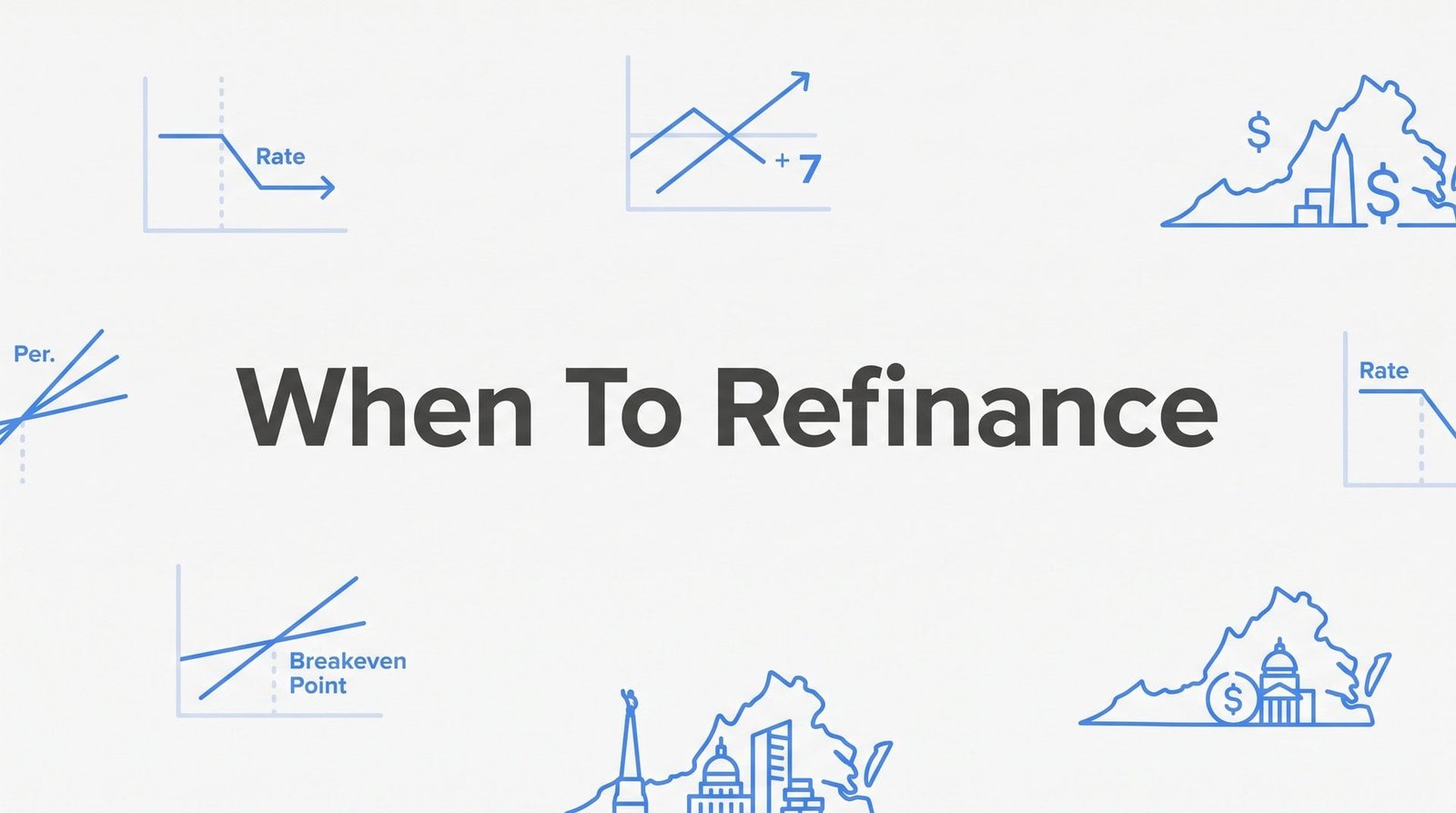
The simplest calculation divides total refinance costs by the monthly savings. In the $400,000 example above, $6,000 divided by $66.82 equals 89.8 months. If you expect to sell, refinance again, or pay off the mortgage before roughly seven and a half years, the payment savings alone does not recover the cost.
That calculation is useful, but incomplete. It should include whether you are bringing cash to closing, receiving a credit, financing eligible costs, changing mortgage insurance, or using points to reduce the note rate. Ask about our no-out-of-pocket closing options, but recognize that a credit used to offset closing expenses normally comes with a pricing trade-off. The cost still exists. It is reflected in the rate or loan structure rather than paid from a checking account at closing.
Points are prepaid interest. One point equals 1% of the loan amount, so one point on a $400,000 loan is $4,000. Paying points can make sense when the lower rate produces a fast enough break-even and you expect to keep that mortgage long enough. It is less compelling when you may move, sell, or refinance again soon.
APR helps show the cost of financing over time because it incorporates certain charges, while the interest rate drives the note rate and principal-and-interest payment. Neither number replaces a line-by-line comparison of the Loan Estimate. Compare the same loan term, lock period, points, credits, and projected time in the home.
Why Broker Pricing Changes an Early Refinance Decision
A retail bank or direct online mortgage platform can offer only its own menu. A broker can submit one borrower profile across a broad wholesale market, then compare rate, points, credit, lock terms, and underwriting fit. BetterMortgageRates.com uses access to 500+ wholesale options to create that comparison rather than asking a borrower to accept one shelf.
Rocket Mortgage and Movement Mortgage are recognizable examples of companies with dedicated product and pricing structures. Their offers may be competitive for a specific borrower on a specific day. The analytical question is not whether any one company is “good” or “bad.” It is whether a single menu can beat a marketplace comparison after points, credits, and lock terms are standardized.
| Channel | Investor access | Rate options | FICO floor | Points and credit flexibility | Lock terms |
|---|---|---|---|---|---|
| Independent broker | Multiple wholesale investors | Compare programs and pricing | Varies by investor and program | Can compare par pricing, points, and credits | Multiple investor-specific lock choices |
| Retail bank | Single institutional shelf | Limited to that bank’s offerings | Set by bank policy and program | Bank-specific pricing menu | Bank-specific lock policy |
| Credit union | Single or limited correspondent shelf | Often narrower program selection | Set by credit union policy | Credit union-specific options | Credit union-specific lock policy |
| Online mortgage platform | Platform-specific shelf | Digitally quoted program menu | Set by platform and program | Platform-specific points and credits | Platform-specific lock policy |
The advantage is pricing transparency, not a promise that every profile receives the same result. A 760 FICO score can price differently than a 739 score. A condominium can price differently than a detached home. A 15-day lock can price differently than a 45-day lock. The only fair comparison is a matched comparison.
Protect Your Credit While You Compare
Rate shopping should not force you to collect unnecessary hard inquiries. A soft credit pull mortgage review can identify score range, liabilities, and likely pricing before a full application is submitted. BetterMortgageRates.com offers the NoTouch Credit Pull to help borrowers begin with clarity.
A no hard inquiry mortgage pre approval conversation is especially useful when you are still deciding whether an early refinance clears your break-even. A mortgage pre approval without hard pull can help you compare scenarios without making credit protection an afterthought. With a soft pull mortgage broker, borrowers can evaluate options before authorizing a full credit report where permitted and appropriate.
A no credit hit mortgage application does not mean underwriting can always be completed without a hard inquiry. It means the initial comparison can start with less friction. The NoTouch Credit Pull is designed for the shopping stage, when borrowers need information before commitment.
FAQ: Can I Refinance Early?
1. Can I refinance one month after closing?
Usually, yes, if the new program permits it and there is no prepayment penalty or program-specific seasoning issue. Cash-out refinances may have additional rules.
2. Is refinancing early bad for my credit?
A completed refinance generally requires credit review, but a soft credit pull mortgage review can help you compare preliminary scenarios before a hard inquiry is authorized.
3. How much lower should my rate be before refinancing?
There is no universal rate-drop rule. Calculate closing costs, monthly savings, loan term, mortgage insurance changes, and your expected time in the home.
4. Should I compare APR or interest rate?
Compare both. The interest rate affects the note and payment; APR incorporates certain finance charges. Then verify points, credits, and fees on matching Loan Estimates.
5. Can I refinance with points?
Yes. Points can lower the rate, but their cost must be recovered through savings before your expected payoff, sale, or next refinance date.
6. Why can a broker show different refinance options?
A broker can compare multiple wholesale investors, while a bank, credit union, or online platform generally presents its own pricing shelf.
7. Should I lock my refinance rate immediately?
Lock when the pricing meets your financial target and the closing timeline is realistic. A longer lock can cost more, while a shorter lock can create extension risk.
8. Can I refinance if I owe more than my home is worth?
Possibly, but options depend on the program, property value, current loan type, payment history, and eligibility rules. A full review is required.
Early refinancing is not a reward for guessing where rates will go. It is a decision to make when matched pricing, documented costs, and your ownership timeline produce a result you can defend with math.
Legal disclaimer: This article is educational and is not a commitment to lend, a loan approval, or financial, tax, or legal advice. Loan terms, eligibility, pricing, and availability change and are subject to credit, income, assets, property review, and program guidelines. Mortgage origination services are available only where properly licensed: VA, FL, TN, and GA.
Duane Buziak | Mortgage Maestro | NMLS #1110647 | Coast2Coast Mortgage, LLC NMLS #376205 | Licensed in VA, FL, TN, GA & DC [Contact] | NoTouch Credit Pull available — no hard inquiry, no credit hit.