
Buying a home in Virginia is one of the largest financial decisions you will ever make. Whether you are eyeing a Colonial in Short Pump, a ranch in Chesterfield, a craftsman bungalow in Charlottesville, or a townhome near Virginia Beach, the process follows a predictable sequence. Understanding that sequence before you begin gives you a decisive edge over buyers who are learning on the fly. Updated September 2026 with current Virginia market conditions, loan program guidance, and settlement requirements.
Quick Answer (45–60 words): The eight essential steps every Virginia homebuyer must master are: (1) assess financial readiness, (2) get pre-qualified via NoTouch soft pull — no hard inquiry, no credit score impact, (3) choose the right loan type, (4) build your team, (5) search strategically and make a competitive offer, (6) navigate inspection and appraisal, (7) lock your rate at the right moment, and (8) close with confidence on settlement day. Start with a free NoTouch Credit Pull.
The challenge is that most buyers encounter each step for the first time under pressure. You are negotiating an offer while simultaneously trying to understand what an appraisal contingency means. You are comparing loan programs while a seller’s deadline is ticking. That reactive posture costs money and causes unnecessary stress.
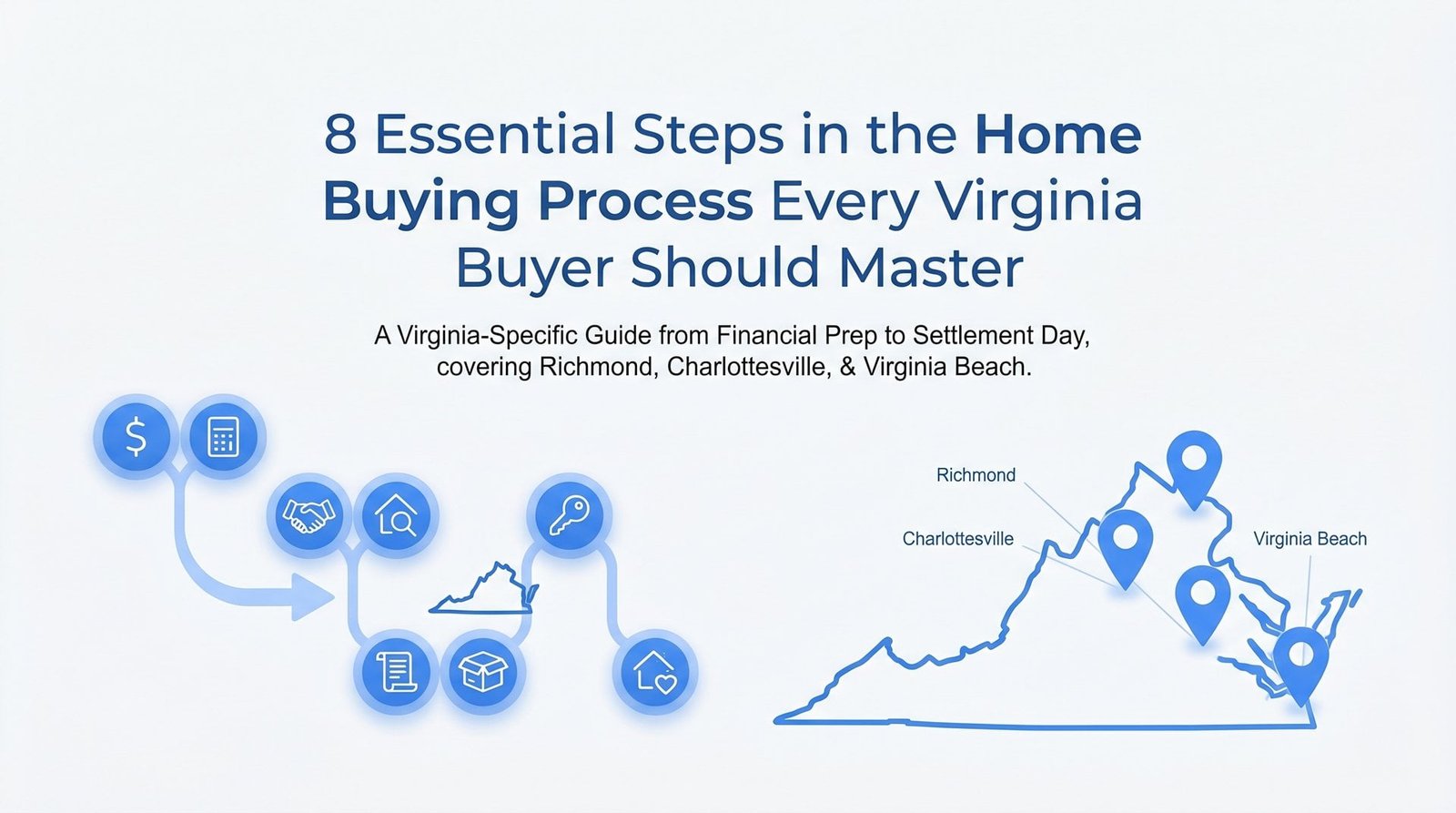
This guide walks you through the eight essential steps in the home buying process, from assessing your financial readiness to collecting the keys on settlement day. Each step includes concrete, Virginia-specific guidance for markets including Richmond, Fredericksburg, Hampton Roads, Charlottesville, Roanoke, Lynchburg, and the surrounding counties. You will find structured comparison tables, worked math examples, and honest answers to the questions buyers actually ask.
The most important first step is also the most overlooked: get pre-approved the right way. At Better Mortgage Rates, every Virginia homebuyer starts with our NoTouch Credit Pull — a true soft credit pull mortgage pre-approval that shows you your full rate picture across hundreds of wholesale lenders with no hard inquiry mortgage pre approval. Unlike Rocket Mortgage or most retail banks, we operate as a soft pull mortgage broker, which means your first look at your buying power is a mortgage pre approval without hard pull. It’s a no credit hit mortgage application from the very first conversation — so you walk into every home tour already knowing exactly what you can afford and at what rate. Learn more about how to shop for a mortgage without hurting your credit.
For current Virginia mortgage rates — including rates for your specific loan type, credit tier, and county — visit our Live Rates tool at BetterMortgageRates.com. Rates shift daily; never rely on static numbers published in any article, including this one.
Use this guide as your roadmap. Read it before you tour a single home.
Author: Duane Buziak, Mortgage Maestro, NMLS #1110647 | Coast2Coast Mortgage LLC, NMLS #376205 | VA Broker of the Year 2024 & 2025 | Scotsman Guide Top Originator 2025 ($44.4M) & 2026 ($51.2M) | UWM PRO ELITE 2025 | Top 1% Nationwide | Serving Virginia, Florida, Tennessee & Georgia
1. Assess Your Financial Readiness Before You Browse a Single Listing
The Challenge It Solves
Many buyers start their search emotionally rather than financially. They fall in love with a home they cannot yet qualify for, or they qualify for a loan that stretches their budget uncomfortably thin. Assessing your financial position first means you search within a realistic range and avoid the heartbreak of a declined application after an accepted offer.
The Strategy Explained
Financial readiness involves four distinct components: your credit profile, your debt-to-income ratio (DTI), your available savings, and your true all-in housing budget. Each one affects what you can borrow, at what rate, and how comfortably you can sustain homeownership after closing.
Credit Profile: Your credit score for mortgage qualification influences your interest rate tier and loan program eligibility. You can check your score without triggering a hard inquiry using a NoTouch Credit soft pull, which means zero impact to your score during the exploration phase.
Debt-to-Income Ratio: Lenders typically evaluate your total monthly debt obligations as a percentage of your gross monthly income. Conventional loans generally allow a back-end DTI up to 45-50% depending on the program and compensating factors. FHA allows slightly higher in some cases. Knowing your DTI before you apply tells you whether you need to pay down any existing debt first.
Savings Assessment: Down payment is only part of the picture. You also need closing costs (typically 2-5% of the loan amount in Virginia), cash reserves, and moving costs. Budget for all three.
Virginia Property Tax Context: Property tax rates vary meaningfully across Virginia localities. Chesterfield, Henrico, and Hanover counties each carry different millage rates. HOA fees in communities throughout Short Pump, Midlothian, and Williamsburg can add hundreds of dollars per month to your true housing cost. Factor these into your budget before you determine your purchase price ceiling.
Implementation Steps
1. Request a soft-pull credit review to see your current score and identify any derogatory items to address before applying.
2. Calculate your current back-end DTI: add all monthly minimum debt payments and divide by your gross monthly income.
3. Build a complete savings inventory: down payment funds, closing cost reserves, and a post-closing emergency cushion.
4. Research property tax rates and any HOA fees in your target Virginia city or county before setting your maximum purchase price.
Pro Tips
Do not rely solely on online mortgage calculators. They rarely account for property taxes, HOA dues, PMI, or homeowner’s insurance accurately. Build a full payment estimate with a licensed mortgage professional who knows your specific Virginia market. This single step prevents the most common and costly surprise in the home buying process.
2. Get Pre-Qualified to Strengthen Your Offer
The Challenge It Solves
In competitive Virginia markets like Richmond, Short Pump, and Hampton Roads, sellers frequently receive multiple offers. A buyer without a pre-qualification letter is often dismissed outright. More importantly, the quality of your pre-qualification letter signals to the seller’s agent how seriously you have been vetted and how likely your financing is to close.
The Strategy Explained
Pre-qualification and pre-approval are not the same thing, and the distinction matters.
Pre-Qualification: A preliminary assessment based on self-reported income, assets, and credit information. It gives you a general borrowing range and can be completed quickly, often without a hard credit inquiry when done through a broker using a soft-pull process.
Pre-Approval: A more rigorous review where the lender verifies income documents, tax returns, bank statements, and pulls a full credit report. A pre-approval letter carries significantly more weight with sellers and listing agents.
Working with a mortgage broker who shops hundreds of lenders simultaneously provides an important structural advantage here. Rather than receiving one rate quote from a single institution, a broker can surface the most competitive program across a wide lender network without requiring multiple hard credit pulls. This matters both for your score and for the range of programs available to you. Learn more about how to shop for a mortgage without hurting your credit during this phase.
Direct lenders like Rocket Mortgage, Movement Mortgage, or Veterans United offer streamlined digital experiences and can be excellent choices for borrowers whose profiles fit neatly into a standard product. A broker adds value when your situation is more complex, when you want rate competition across many lenders, or when you want to explore non-QM or specialty programs alongside conventional options.
Implementation Steps
1. Start with a NoTouch Credit soft-pull pre-qualification to understand your range without a hard inquiry.
2. Gather your income documents: two years of W-2s or tax returns, recent pay stubs, and two to three months of bank statements.
3. Discuss your timeline and target purchase price with your mortgage professional to determine whether pre-qualification or full pre-approval is the right next step.
4. Obtain a pre-qualification or pre-approval letter before you begin touring homes.
Pro Tips
Ask your mortgage professional to write the pre-qualification letter for a specific price range rather than your maximum approval amount. This protects your negotiating position. A seller does not need to know your absolute ceiling when you are making an offer below it.
3. Choose the Right Loan Type for Your Situation
The Challenge It Solves
Virginia buyers have access to several distinct loan programs, each with different eligibility requirements, down payment minimums, mortgage insurance structures, and geographic restrictions. Choosing the wrong program can mean paying thousands more over the life of the loan, or missing eligibility for a zero down payment loan option you qualify for.
The Strategy Explained
The four primary loan programs available to Virginia buyers are Conventional, FHA, VA, and USDA. Here is how they compare on the dimensions that matter most:
Loan Program Comparison Table
Conventional: Minimum down payment of 3-5% (per Fannie Mae/Freddie Mac guidelines); minimum credit score typically 620+; PMI required if down payment is below 20%; available statewide; no geographic restriction; conforming loan limit applies (baseline limit for most Virginia counties outside excluded areas).
FHA: Minimum down payment of 3.5% with a 580+ credit score (per HUD/FHA guidelines); 10% down required for scores 500-579; mortgage insurance premium (MIP) required for the life of the loan in most cases; available statewide; good option for buyers rebuilding credit or with limited down payment savings. For a detailed breakdown of how these two programs compare, see our guide on FHA vs conventional loans.
VA: Zero down payment required; no PMI; no minimum credit score set by VA (lenders overlay their own minimums); available to eligible veterans, active-duty service members, and surviving spouses per U.S. Department of Veterans Affairs guidelines; particularly relevant in Hampton Roads, Williamsburg, Yorktown, and other military-adjacent Virginia communities.
USDA: Zero down payment for eligible rural areas per USDA Rural Development program guidelines; income limits apply; geographic eligibility required. In Virginia, counties including Louisa, Caroline, Goochland, and parts of Hanover have eligible areas. This is an underutilized program that many buyers in these counties do not know they qualify for.
Virginia Conforming Loan Limit Note: For most Virginia counties outside the Northern Virginia/DC metro area (which this guide excludes), the standard baseline conforming loan limit applies. Verify the current annual limit with FHFA at fhfa.gov or with your mortgage professional, as FHFA updates this figure annually.
Implementation Steps
1. Confirm your VA eligibility if you are a veteran or active-duty service member. This is often the most financially advantageous program available.
2. Check USDA eligibility for your target county if you are considering areas like Louisa, Caroline, Goochland, or Lake Anna.
3. Compare the total cost of FHA vs. Conventional by running both scenarios with your mortgage professional, including the impact of PMI vs. MIP over your expected ownership timeline.
4. Confirm current conforming loan limits at fhfa.gov if your purchase price approaches the limit.
Pro Tips
Do not default to the loan type you have heard of most. Run the numbers on every program you qualify for. For many Virginia buyers in rural or semi-rural counties, USDA delivers exceptional value that goes overlooked simply because buyers assume they need a down payment. For eligible veterans anywhere in Virginia, VA is almost always worth a serious look first.
4. Build Your Home Buying Team: Agent, Lender, and Attorney
The Challenge It Solves
Home buying is a team sport, and the professionals you choose directly affect your outcome. A weak link in your team, whether that is a buyer’s agent unfamiliar with your target market or a lender who misses a program you qualify for, can cost you a competitive offer or thousands of dollars at closing.
The Strategy Explained
Your core team has three essential members: a buyer’s agent, a mortgage professional, and a real estate attorney. In Virginia, the attorney is not optional. Virginia is an attorney-closing state, meaning settlements must be conducted by or under the supervision of a licensed Virginia attorney. This is established Virginia law, not a preference.
Buyer’s Agent: Choose an agent with demonstrated experience in your specific target market. An agent who specializes in Midlothian and Chesterfield may not have the same depth of knowledge in Fredericksburg or Spotsylvania. Ask about recent comparable transactions, average days on market in your price range, and their approach to multiple-offer situations.
Mortgage Professional: Broker vs. Direct Lender: Different lender types serve different needs. A direct lender like Rocket Mortgage, Movement Mortgage, PrimeLending, or Atlantic Bay Mortgage offers a focused, often digitally streamlined experience within their own product set. They know their programs well and can move efficiently for borrowers whose profiles fit their criteria.
A mortgage broker shops hundreds of lenders simultaneously. This means your application can be matched against a much wider range of programs and rate tiers, potentially surfacing options a single institution cannot offer. For borrowers with complex income situations, self-employment, or non-standard profiles, this breadth can make a meaningful difference. Our guide to home loan options in Virginia explains how different lender structures affect the programs available to you.
Real Estate Attorney: Your attorney handles the closing, reviews title, and ensures the transaction is legally sound. In Virginia, this is a required participant, not an add-on. Budget for attorney fees as part of your closing cost estimate.
Implementation Steps
1. Interview at least two buyer’s agents with verifiable transaction history in your target Virginia city or county.
2. Decide between a broker and direct lender based on your profile complexity and desire for rate competition across multiple lenders.
3. Confirm your closing attorney is licensed in Virginia and familiar with your county’s recording and settlement requirements.
4. Establish communication expectations with all three team members early so no one is surprised by timelines or document requests.
Pro Tips
Your mortgage professional and buyer’s agent should be able to communicate directly and efficiently. Delays in the financing process are one of the most common reasons contracts fall through. Choose professionals who are responsive and accustomed to working collaboratively under contract deadlines.
5. Search Strategically and Make a Competitive Offer
The Challenge It Solves
Unfocused home searches waste time and create decision fatigue. Buyers who have not defined their priorities clearly often find themselves touring homes that do not fit their actual needs, or hesitating when the right home appears because they have not thought through their offer strategy in advance.
The Strategy Explained
Effective searching starts with a written priority list, not a Zillow scroll. Separate your requirements into three tiers: must-haves, strong preferences, and nice-to-haves. This framework forces clarity and makes offer decisions faster when you find a home that checks the essential boxes.
Virginia market dynamics vary significantly by location. Richmond and its suburbs, including Short Pump, Glen Allen, and Midlothian, have experienced sustained demand with limited inventory in certain price tiers. Fredericksburg and Spotsylvania attract buyers priced out of Northern Virginia (excluded from this guide) and have their own competitive dynamics. Hampton Roads encompasses a diverse set of submarkets, from Virginia Beach to Suffolk to Chesapeake, each with different price points and inventory levels. Charlottesville and Albemarle County carry a premium driven by the University of Virginia employment base. Roanoke and Lynchburg offer more buyer-friendly conditions in many price ranges.
Understanding your specific submarket before you make an offer means you know whether to expect bidding wars, how much over list price comparable homes are selling for, and what contingencies sellers in that market are likely to accept or push back on.
Offer Structure Considerations:
Earnest Money: A stronger earnest money deposit signals commitment. What is considered competitive varies by market and price point. Your buyer’s agent should advise on local norms.
Contingencies: Financing and inspection contingencies protect you. In highly competitive markets, some buyers waive or modify contingencies. Understand the risk clearly before doing so, and never waive a financing contingency without a thorough conversation with your mortgage professional about how certain your approval is. If you want to strengthen your position, understanding how to improve your mortgage approval odds before making an offer gives you a significant advantage.
Closing Timeline: Sellers often have a preferred timeline. A flexible closing date can be as compelling as a higher price in some situations.
Implementation Steps
1. Write your three-tier priority list before your first showing.
2. Ask your buyer’s agent to pull recent comparable sales data in your target area to calibrate offer pricing.
3. Discuss contingency strategy with both your agent and mortgage professional before you are under contract pressure.
4. Confirm your earnest money funds are accessible and ready to wire or deposit within the timeframe specified in the contract.
Pro Tips
In Virginia, the standard purchase contract is the Virginia Realtors form. Understand the key dates and deadlines within it before you sign. Your attorney and agent can walk you through it. The most expensive mistakes in real estate happen when buyers sign documents they do not fully understand under time pressure.
6. Navigate Inspection, Appraisal, and Due Diligence
The Challenge It Solves
The due diligence phase is where deals either solidify or unravel. Buyers who do not understand what inspections cover, what an appraisal is actually measuring, or how to evaluate repair requests often make costly decisions: either accepting problems they should have negotiated, or killing a good deal over issues that are normal for the home’s age and price point.
The Strategy Explained
A standard home inspection in Virginia covers the visible and accessible components of the home: structure, roof, electrical, plumbing, HVAC, insulation, and more. It does not cover everything, and understanding the limitations matters.
Virginia-Specific Inspection Considerations:
Radon: Radon is a documented concern in parts of central Virginia, including areas around Charlottesville, Albemarle, and portions of the Piedmont region. A radon test is a separate add-on to a standard inspection and is worth requesting, particularly in these areas.
Moisture and Humidity: Hampton Roads, Tidewater, and coastal Virginia communities have elevated humidity levels that can contribute to crawl space moisture issues, mold, and wood rot. A thorough inspection in these areas should include crawl space evaluation. Consider a separate moisture or mold inspection if the standard inspector notes any concerns.
The Appraisal: The appraisal is ordered by your lender and protects both you and the lender by confirming the property’s market value supports the loan amount. If the appraisal comes in below the purchase price, you have several options: renegotiate the price with the seller, pay the difference in cash, challenge the appraisal with comparable sales data (through your agent), or walk away if you have an appraisal contingency.
Repair Negotiation vs. Credit: A Breakeven Framework:
When an inspection reveals issues, you have two primary options: ask the seller to make repairs before closing, or request a closing cost credit and handle repairs yourself after closing. The right choice depends on the nature of the repair and your confidence in the seller’s contractor.
For significant mechanical systems (HVAC, roof, electrical panels), a credit is often preferable because you control the quality of the repair. For cosmetic issues, either approach can work. For safety items, insist on remediation before closing or a substantial credit that fully covers the repair cost plus a reasonable contingency. Our detailed guide on how to qualify for a mortgage covers how repair credits and appraisal outcomes can affect your final loan terms.
Implementation Steps
1. Schedule your home inspection promptly after going under contract. Do not delay, as your inspection contingency period is time-limited.
2. Attend the inspection in person. Walking through with the inspector gives you context that a written report alone cannot provide.
3. Request a radon test if you are purchasing in central Virginia or any area with documented radon risk.
4. Review the appraisal report carefully with your mortgage professional and understand your options if it comes in below purchase price.
Pro Tips
Do not use the inspection as a renegotiation tool for minor cosmetic items. Sellers notice, and it can sour a transaction that was otherwise proceeding smoothly. Reserve your negotiating capital for genuine material defects, safety issues, or items that represent significant future expense. Your buyer’s agent can help you calibrate what is worth pushing on in your specific market.
7. Lock Your Rate and Finalize Loan Terms at the Right Moment
The Challenge It Solves
Interest rates move daily, and the difference between locking at the right time versus waiting can meaningfully affect your monthly payment and total interest cost. Many buyers also face the question of whether to pay discount points to buy down their rate, without a clear framework for evaluating whether that makes financial sense for their situation.
The Strategy Explained
A rate lock is a commitment from your lender to hold a specific interest rate for a defined period, typically 30, 45, or 60 days, while your loan processes. Once you are under contract and your loan is in process, your mortgage professional will discuss lock timing with you.
Rate locks generally cannot be initiated before you have a ratified purchase contract. Lock periods vary in cost: longer locks often carry a slightly higher rate or fee to compensate the lender for the extended commitment.
Rate and Payment Comparison Table (Illustrative Example):
The following is a hypothetical illustration using a $350,000 loan amount on a 30-year fixed mortgage. These figures are for educational purposes only and do not represent a rate quote. Actual rates vary based on credit profile, loan type, property type, and market conditions at the time of application.
At 6.50%: Estimated monthly principal and interest (P&I) = approximately $2,213
At 6.75%: Estimated monthly P&I = approximately $2,270
At 7.00%: Estimated monthly P&I = approximately $2,329
At 7.25%: Estimated monthly P&I = approximately $2,388
The difference between 6.75% and 7.00% on a $350,000 loan is approximately $59 per month, or roughly $708 per year. For a deeper look at how even small rate differences compound over time, see our mortgage rate comparison strategies guide.
Discount Points Breakeven Math (Illustrative):
One discount point equals 1% of the loan amount paid upfront at closing in exchange for a lower interest rate. The rate reduction per point varies by lender and market conditions.
Illustrative example: On a $350,000 loan, one discount point costs $3,500. If that point reduces your rate from 7.00% to 6.75%, saving approximately $59 per month:
Breakeven calculation: $3,500 upfront cost divided by $59 monthly savings = approximately 59 months, or just under 5 years.
If you plan to stay in the home longer than 5 years, buying the point may make financial sense. If you expect to sell or refinance before that breakeven, paying the point upfront likely does not benefit you. This is the core of the points decision, and it is always a personal calculation based on your specific loan terms and expected ownership horizon.
Implementation Steps
1. Ask your mortgage professional to provide rate quotes at multiple price points: rate with no points, rate with one point, and rate with two points.
2. Calculate the breakeven on any points scenario using the formula above.
3. Discuss lock timing with your mortgage professional once you are under contract, factoring in your closing date and any rate trend observations.
4. Confirm your lock confirmation in writing once the lock is placed.
Pro Tips
Rate shopping across multiple lenders is one of the most impactful actions a borrower can take. Even a 0.25% rate difference on a $350,000 loan represents meaningful savings over time. A mortgage broker who shops hundreds of lenders simultaneously does this work on your behalf, surfacing competitive pricing that a single-lender application cannot match by definition. This is one of the clearest structural advantages of working with a broker rather than applying to a single institution directly.
8. Close with Confidence on Settlement Day in Virginia
The Challenge It Solves
Settlement day should be the culmination of weeks of careful preparation, not a source of last-minute confusion. Buyers who arrive at closing without understanding the documents they will sign, the funds they need to bring, or what the final walk-through is meant to accomplish often feel rushed and uncertain at the exact moment they should feel informed and confident.
The Strategy Explained
Virginia is an attorney-closing state. Your settlement will be conducted by or under the supervision of a licensed Virginia real estate attorney. The attorney handles the legal transfer of title, reviews and prepares closing documents, disburses funds, and records the deed with the appropriate county or city clerk’s office.
What to Expect at the Closing Table:
You will review and sign a substantial package of documents including the Closing Disclosure (which you should receive at least three business days before closing), the promissory note, the deed of trust, and various lender-required disclosures. Your attorney will explain each document. Do not hesitate to ask questions.
Virginia Closing Cost Breakdown (Illustrative Ranges):
Lender origination fees: Varies by lender and loan program; ask for a Loan Estimate early in the process.
Title insurance (owner’s and lender’s): Typically required; costs vary by purchase price and county.
Attorney/settlement fees: Varies by firm and transaction complexity.
Recording fees: Set by the Virginia locality where the property is located.
Prepaid items: Homeowner’s insurance premium, prepaid interest from closing date to end of month, and initial escrow deposits for taxes and insurance.
Total closing costs in Virginia: Typically range from approximately 2% to 5% of the loan amount, though your Closing Disclosure will show the exact figures for your transaction. For specific strategies to minimize these expenses, review our guide on how to reduce your mortgage closing costs in Virginia.
Final Walk-Through Checklist:
The final walk-through typically occurs within 24 hours of closing. Its purpose is to confirm the property is in the agreed-upon condition, that any negotiated repairs have been completed, and that no new damage has occurred since your inspection. Check all appliances, plumbing fixtures, HVAC operation, and any items specifically noted in your repair addendum. If something is wrong, contact your agent immediately before signing closing documents.
Common Last-Minute Surprises to Avoid:
Do not make large deposits or withdrawals in your bank accounts after your loan is approved. Lenders re-verify assets close to closing, and unexplained account activity can delay or derail your loan.
Do not open new credit accounts or make major purchases on credit between pre-approval and closing. New debt changes your DTI and can affect your approval.
Bring a certified or cashier’s check or arrange a wire transfer for your closing funds. Personal checks are generally not accepted at Virginia closings. Confirm the exact wire instructions with your attorney directly, and verify the wire instructions by phone before sending any funds.
Implementation Steps
1. Review your Closing Disclosure carefully when you receive it, at least three business days before closing. Compare it to your Loan Estimate and flag any unexpected changes with your mortgage professional.
2. Complete your final walk-through within 24 hours of closing and document any concerns with photos.
3. Arrange your closing funds via wire transfer or certified check in the exact amount shown on your Closing Disclosure.
4. Bring a government-issued photo ID to closing. Your attorney will require it.
Pro Tips
Wire fraud targeting real estate transactions is a documented and serious risk. Always verify wire instructions by calling your closing attorney directly using a phone number you have independently confirmed, not a number provided in an email. Never wire funds based solely on email instructions, even if the email appears to come from someone you know in the transaction.
Frequently Asked Questions
How long does the home buying process take in Virginia?
From pre-qualification to closing, the process typically takes 30 to 60 days once you are under contract. The search phase varies widely depending on market conditions and how quickly you find the right home. Getting pre-qualified before you begin searching compresses the overall timeline significantly.
Do I need a down payment to buy a home in Virginia?
Not necessarily. VA loans offer zero down payment to eligible veterans and active-duty service members. USDA loans offer zero down payment in eligible rural areas of Virginia, including parts of Louisa, Caroline, Goochland, and other counties. FHA loans require as little as 3.5% down with a 580+ credit score. Conventional loans are available with as little as 3% down in some programs.
What is a NoTouch Credit pre-qualification?
A NoTouch Credit pre-qualification uses a soft credit pull, which does not affect your credit score, to give you a preliminary assessment of your borrowing range. It allows you to explore your options and understand your position before committing to a full application. This is particularly valuable early in the process when you are still deciding on timing, loan type, or purchase price range.
How is a mortgage broker different from a direct lender?
A direct lender originates loans using their own funds and product set. A mortgage broker works with hundreds of lenders and matches your profile to the most competitive programs across that network. Both serve legitimate purposes. A broker’s primary advantage is access to a wider range of programs and the ability to shop your loan across many lenders simultaneously, which can surface better rates or programs than any single institution can offer on its own.
Is Virginia an attorney-closing state?
Yes. Virginia law requires that real estate settlements be conducted by or under the supervision of a licensed Virginia attorney. Your closing attorney is a required member of your home buying team, not an optional add-on.
What credit score do I need to buy a home in Virginia?
It depends on the loan program. FHA loans are available with a 580+ credit score for the 3.5% down payment option, per HUD guidelines. Conventional loans typically require a 620+ score, though better rates are available at higher score tiers. VA loans do not have a VA-mandated minimum score, though individual lenders set their own overlays. USDA loans generally require a 640+ score for streamlined processing. A soft-pull credit review can tell you exactly where you stand before you apply.
What are typical closing costs in Virginia?
Closing costs in Virginia typically range from approximately 2% to 5% of the loan amount, encompassing lender fees, title insurance, attorney and settlement fees, recording fees, and prepaid items such as homeowner’s insurance and initial escrow deposits. Your Loan Estimate, provided within three business days of application, will show itemized costs for your specific transaction.
Can I buy a home in rural Virginia with no down payment?
Potentially yes, through the USDA Rural Development loan program. Several Virginia counties, including Louisa, Caroline, Goochland, and portions of Hanover, have areas that qualify under USDA geographic eligibility. Income limits apply. Confirm current eligibility at the USDA’s official eligibility tool or discuss with a mortgage professional familiar with rural Virginia lending.
Your Next Steps: A Prioritized Implementation Roadmap
The eight steps above form a complete sequence, and the sequence matters. Skipping step one to get to step five is how buyers end up in financial situations that do not serve them. Here is how to prioritize your immediate actions.
If you are more than 90 days from buying: Focus on steps one and three. Assess your financial readiness thoroughly, understand which loan programs you may qualify for, and use the time to address any credit or savings gaps you identify.
If you are 30 to 90 days from buying: Move through steps two and four immediately. Get pre-qualified, assemble your team, and begin your strategic search with a clear priority framework.
If you are actively under contract: Steps six, seven, and eight are your focus. Stay disciplined about your finances, engage fully in the due diligence process, and arrive at closing prepared and informed.
Duane Buziak, Mortgage Maestro, NMLS#1110647, works with homebuyers across Virginia, including Richmond, Short Pump, Glen Allen, Chesterfield, Midlothian, Henrico, Hanover, Fredericksburg, Spotsylvania, Stafford, Prince William, Ashland, Lake Anna, Goochland, Louisa, Caroline County, Charlottesville, Albemarle, Williamsburg, Yorktown, Suffolk, Hampton Roads, Newport News, Chesapeake, Virginia Beach, Roanoke, and Lynchburg, as well as buyers in Florida, Tennessee, and Georgia.
The process starts with a conversation and a soft-pull credit review that will not affect your score. Learn more about our services and take the first step toward your Virginia home purchase with complete confidence in your financial position.
Legal Disclaimer: This article is for educational and informational purposes only and does not constitute financial, legal, or mortgage advice. Loan program guidelines, interest rates, eligibility requirements, and conforming loan limits are subject to change. All rate and payment figures presented in this article are hypothetical illustrations only and do not represent a commitment to lend or a rate quote. Actual loan terms depend on individual creditworthiness, property type, loan amount, and market conditions at the time of application. USDA and VA loan eligibility is subject to program guidelines and lender requirements. Consult a licensed mortgage professional for guidance specific to your situation. Duane Buziak, NMLS#1110647. Better Mortgage Rates. Licensed in Virginia, Florida, Tennessee, and Georgia. For additional mortgage guidance, visit consumerfinance.gov (CFPB), hud.gov (FHA/HUD), va.gov (VA loans), and fhfa.gov (conforming loan limits).