
A 0.25% rate difference on a $400,000, 30-year fixed mortgage is not a rounding error. At 6.50%, principal and interest is $2,528.27 per month. At 6.75%, it is $2,594.39 per month. That is $66.12 more each month, $3,967.20 over five years, and $23,803.20 over 30 years if you keep the loan for the full term. That is why the question, when should you lock mortgage rate, deserves more than a guess about where headlines are headed.
The right lock decision is a pricing decision with a deadline. You are weighing the cost of protection against the possibility that pricing improves before closing. The strongest answer comes from your contract date, closing timeline, loan profile, point options, and downside tolerance – not a forecast from television.
Table of Contents
- What a mortgage rate lock actually protects
- When should you lock mortgage rate on a purchase?
- The math behind float versus lock
- Compare broker, retail, and online lock options
- Points, credits, APR, and lock timing
- How to shop without unnecessary credit damage
- Mortgage rate lock FAQs
What a mortgage rate lock actually protects
A lock holds a specific combination of interest rate, points or credits, and expiration date while the file moves toward closing. It does not simply reserve a number. It reserves pricing under stated assumptions: your credit profile, occupancy, property type, loan amount, loan program, debt-to-income ratio, and closing date.
If one of those inputs changes, the pricing can change. A lower appraisal, a switch from primary residence to investment property, or a revised closing date can all matter. A lock also does not guarantee that every fee will remain unchanged. Review the Loan Estimate carefully and ask your broker which costs are fixed, which are third-party estimates, and what happens if the lock expires.
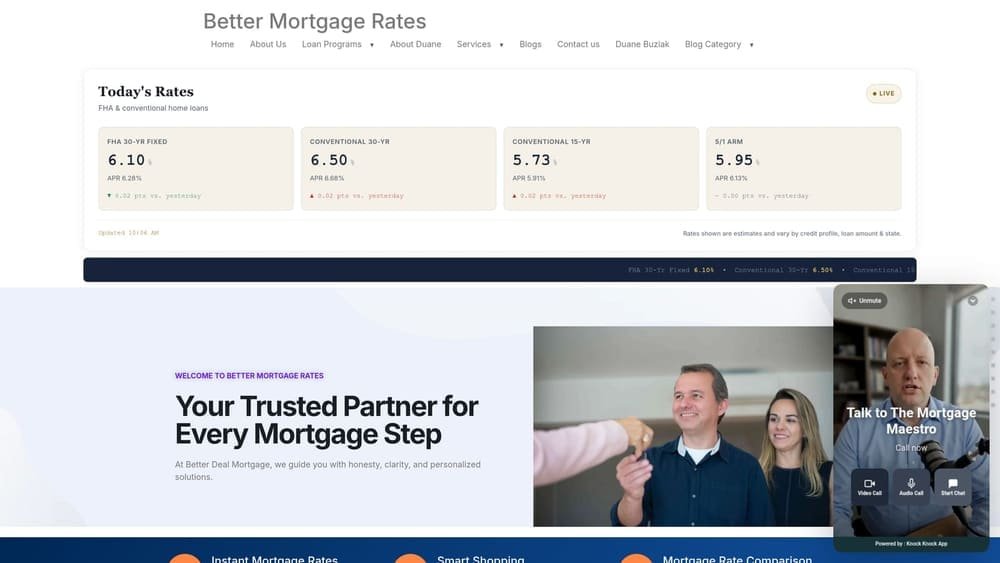
National rate headlines are useful context, but they are not your quote. Freddie Mac’s Primary Mortgage Market Survey is a widely followed national benchmark, yet your actual pricing depends on loan-level adjustments and the investor that best fits your file. A broker can compare that file across a broad wholesale market rather than stopping at one pricing shelf.
Duane Buziak, NMLS #1110647, is licensed in VA, FL, TN, and GA and has built his process around comparing investor pricing before asking a borrower to commit to a lock. His Scotsman Guide Top Originator #114 ranking in 2025 reflected $44.4 million across 124 loans, followed by $51.2 million in 2026. Volume does not replace careful advice, but it does create daily visibility into how different investor rate sheets price the same borrower.
When should you lock mortgage rate on a purchase?
For most purchase borrowers, lock when three things are true: the contract is signed, the loan terms are stable, and the payment works without needing a future rate rally to make the deal comfortable. If the payment only works at a lower rate that has not arrived, the purchase may be too tight.
A 30-day lock is often appropriate when the appraisal, underwriting, and closing schedule are already moving. A 45- or 60-day lock can be sensible when the contract has more distance to cover, the property needs extra review, or the transaction involves a condo, new construction, jumbo financing, or a complex self-employed file. Longer locks often cost more, so do not buy extra days simply because they sound safer. Buy enough time for the actual transaction.
Lock earlier when you have a firm closing date and cannot absorb a higher payment or cash-to-close figure. Float longer only when you understand the risk, the timeline is flexible, and your broker can monitor pricing and explain the downside in dollars. No one can promise that rates will improve before your closing date.
A practical decision rule
Start with the worst reasonable outcome, not the best possible headline. If a 0.125% or 0.25% increase would force you to change your down payment, exceed your debt-to-income comfort zone, or lose sleep, protection has value. Lock it.
If you have substantial payment room and the market improves, a float-down option may help. But read the terms. Some float-down provisions require a minimum improvement, allow only one adjustment, or apply only within a specified period before closing. A float-down is not the same as unlimited upside with no risk.
The math behind floating versus locking
Borrowers sometimes focus on whether rates will fall next week and miss the larger decision: what does delaying cost if pricing moves against them? Use the payment difference, expected time in the home, and cash needed at closing.
In the $400,000 example above, waiting and losing 0.25% adds $66.12 per month. If your realistic holding period is five years, that is $3,967.20 in additional principal-and-interest payments. The comparison is not just rate versus rate. It is the known value of today’s pricing versus the uncertain value of waiting.
Points can change the answer. One point equals 1% of the loan amount, so one point on a $400,000 loan costs $4,000. If paying that point lowers the payment by $60 per month, the simple break-even is 66.7 months, or about five years and seven months. If you expect to refinance or sell before then, the lower note rate may not be the best execution. A lender credit can reduce cash due at closing in exchange for a higher rate, which can be useful when liquidity matters more than a lower payment.
APR helps show the cost of financing over time because it incorporates certain finance charges. It is not a replacement for the interest rate. Compare both, then compare points, credits, projected payment, and break-even using the same loan amount and lock period.
How pricing access changes your lock decision
The rate you lock matters, but where it came from matters first. A single-shelf retail institution can only show its own available pricing. An independent broker can submit one borrower profile across a much broader wholesale market, then compare rate, points, credits, underwriting fit, and lock policy side by side.
| Pricing dimension | Independent broker | Rocket Mortgage | Movement Mortgage | Credit union | Online mortgage platform |
|---|---|---|---|---|---|
| Investor access | Multiple wholesale investor options | Company pricing shelf | Company pricing shelf | Institution-specific programs | Platform-specific investor relationships |
| Rate options | Compared across eligible investors | Available company offerings | Available company offerings | Available credit-union offerings | Available platform offerings |
| FICO floor | Varies by program and investor | Varies by program | Varies by program | Varies by program | Varies by program and platform |
| Points and credit flexibility | Can compare par, points, and credits | Options offered on its shelf | Options offered on its shelf | Options offered on its shelf | Options offered on its shelf |
| Lock terms | Can compare eligible lock policies | Company lock policy | Company lock policy | Institution lock policy | Platform lock policy |
This is not an argument that every broker quote will win every comparison. It is an argument for comparing before you lock. BetterMortgageRates.com uses a 500-plus wholesale investor network to make that comparison visible. Ask for the par-rate option, the cost to buy down, the credit option, the lock expiration date, and the policy if closing is delayed.
Shop the rate before you authorize a lock
Rate shopping should not force you to choose between better pricing and protecting your credit profile. A soft credit pull mortgage review can help establish a planning range before a full application is needed. NoTouch Credit Pull is designed for borrowers who want a no hard inquiry mortgage pre approval conversation while they compare options.
A mortgage pre approval without hard pull can be especially helpful when you are deciding whether points make sense, evaluating a refinance break-even, or comparing conventional, FHA, VA, jumbo, DSCR, and bank-statement options. A soft pull mortgage broker process is not a final underwriting approval, but it can provide a far more useful starting point than guessing from a generic rate advertisement.
Ask directly whether a quote can begin as a no credit hit mortgage application review. Then, once you have selected a program and are ready to proceed, confirm when a hard inquiry is necessary. NoTouch Credit Pull should be used early enough to compare intelligently, not as a reason to delay documentation after you have a signed contract.
Mortgage rate lock FAQs
1. Should I lock my mortgage rate as soon as I am under contract?
Usually, yes, if the payment and cash-to-close work and your closing date is defined. Waiting is a market bet. A lock turns the rate portion of the transaction into a known number.
2. Can I lock before I have an accepted offer?
Some programs allow it, but longer terms can cost more and terms vary. For most buyers, comparing pricing early and locking after contract execution is the cleaner approach.
3. Is APR more important than the interest rate?
Neither stands alone. The interest rate drives principal and interest payment; APR incorporates certain finance charges. Compare both alongside points, credits, and your expected holding period.
4. Are mortgage points worth it?
They are worth considering when the break-even occurs before you expect to sell or refinance. Calculate the exact cost divided by the exact monthly savings.
5. What is a par rate?
Par is generally the rate available without discount points or a lender credit, subject to the borrower profile and lock term. It is a useful baseline for comparing alternatives.
6. Can a broker offer a better lock than a retail institution?
A broker has the structural advantage of comparing eligible wholesale investor pricing. That does not guarantee one outcome, but it creates more rate, point, credit, and lock-policy choices to evaluate.
7. What happens if my lock expires?
Your broker may request an extension, which can carry a cost, or pricing may need to be reissued. Lock a term that reflects the real closing timeline, especially if the file has unusual complexity.
8. Should I float if rates appear to be falling?
Only if you can afford a worse outcome and understand the deadline. If the current payment achieves your goal, certainty is often more valuable than a speculative improvement.
Legal disclaimer: Mortgage pricing, lock availability, points, credits, APR, and underwriting decisions vary by borrower profile, property, program, investor guidelines, and market conditions. This article is educational and not a commitment to lend or a guarantee of rate, approval, or closing. Direct mortgage origination services are offered only where properly licensed.
The best lock is not the lowest rate you saw in a headline. It is the pricing structure that meets your payment, cash, and closing-date goals after you have compared the available options with no confusion.
Duane Buziak | Mortgage Maestro | NMLS #1110647 | Coast2Coast Mortgage, LLC NMLS #376205 | Licensed in VA, FL, TN, GA & DC [Contact] | NoTouch Credit Pull available — no hard inquiry, no credit hit.