Updated September 2026 — Duane Buziak, Mortgage Maestro, NMLS #1110647 | Coast2Coast Mortgage LLC NMLS #376205 | VA Broker of the Year 2024 & 2025 | Scotsman Guide Top Originator 2025 ($44.4M) & 2026 ($51.2M) | UWM PRO ELITE 2025 | Top 1% Nationwide
Picture a family in Goochland County who has spent two years saving for a down payment, watching home prices climb while their savings account tries to keep pace. They assume homeownership requires $15,000–$20,000 at the closing table. Then they discover USDA loans — and realize the home they want qualifies for 100% financing with no down payment required.
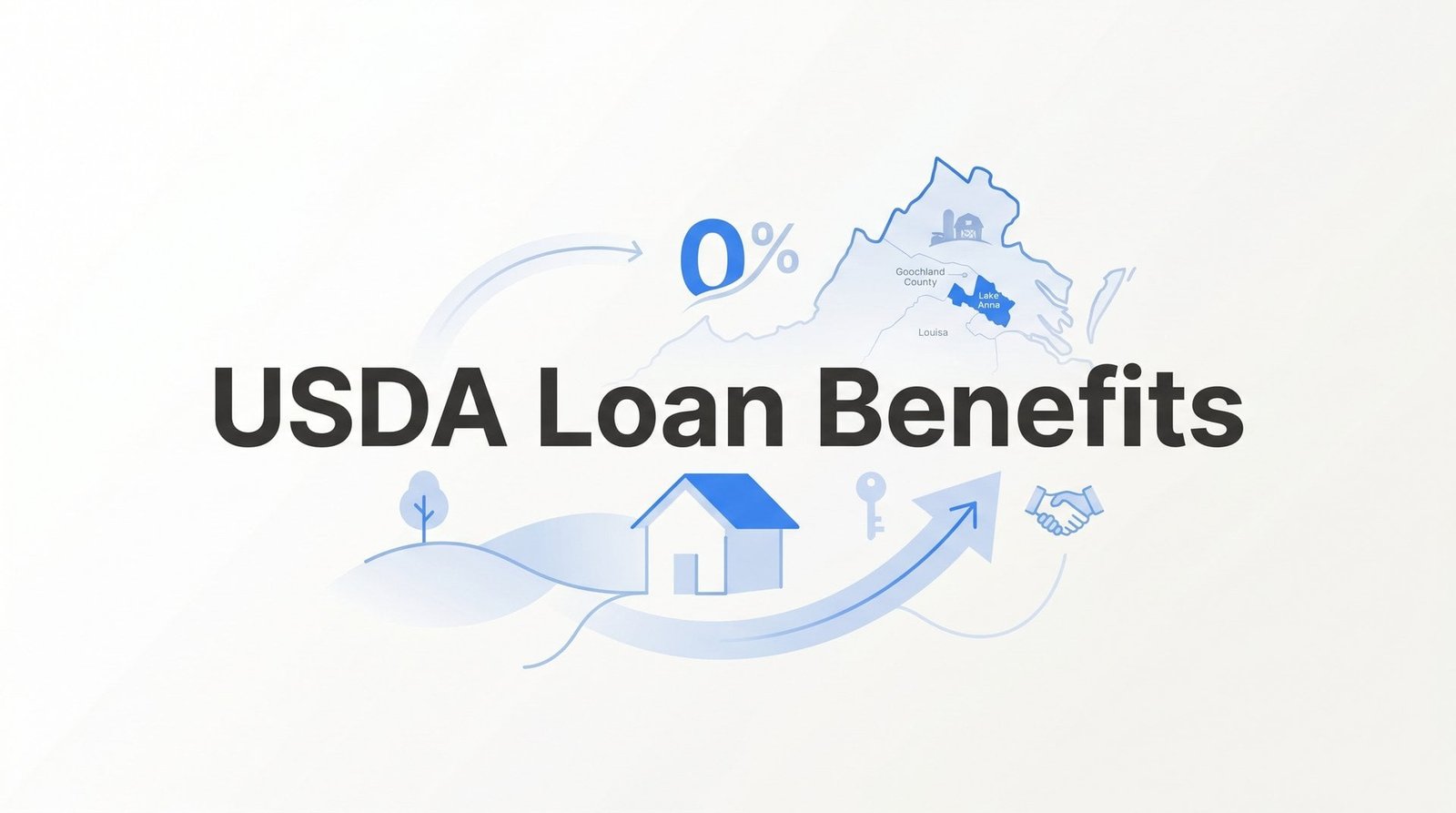
USDA loan benefits for Virginia homebuyers include: zero down payment, no monthly PMI (replaced by a 0.35% annual guarantee fee — lower than FHA’s 0.55% MIP), competitive government-backed rates, seller contributions up to 6%, and no prepayment penalty. Eligibility requires a USDA-designated property location, household income at or below 115% of the area median income, and a primary-residence purchase — making this the most affordable zero-down program for non-military Virginia buyers. (55-word featured snippet.)
This scenario plays out regularly across Virginia. Many buyers in communities like Louisa, Caroline County, Lake Anna, Ashland, and parts of Spotsylvania and Hanover are sitting in USDA-eligible areas without realizing it. The program isn’t just for farms or rural homesteads — it covers a wide range of suburban and small-town communities where families actually want to live.
This guide breaks down USDA loan benefits in plain language: how the program works, what the real financial advantages look like in dollar terms, how USDA stacks up against FHA, conventional, and VA loans, and what the application process actually involves for Virginia buyers. Whether you’re house-hunting near Charlottesville, Williamsburg, Suffolk, or Roanoke, understanding USDA eligibility could change your entire homebuying strategy.
For current USDA mortgage rates in Virginia — rates move daily and no published article can reflect today’s pricing — see our Live Rates comparison tool for a personalized quote.
One more advantage worth knowing up front: with the NoTouch Credit Pull at Coast2Coast Mortgage, you can get pre-approved and shop rates without a hard inquiry. Whether you’re looking for a soft credit pull mortgage, a no hard inquiry mortgage pre approval, or a mortgage pre approval without hard pull, the NoTouch process — used by a dedicated soft pull mortgage broker — delivers a true no credit hit mortgage application so your score is never affected during early exploration. Learn more about how to shop for a mortgage without hurting your credit.
The USDA Rural Development Guaranteed Loan: What It Is and Who Qualifies
The USDA Guaranteed Loan Program — formally known as the Section 502 Single Family Housing Guaranteed Loan Program — is a government-backed mortgage product administered by the U.S. Department of Agriculture’s Rural Development office. The federal guarantee reduces lender risk, which is why lenders can offer 100% financing without requiring a down payment from the borrower.
Three core eligibility requirements determine whether a buyer qualifies:
Property Location: The home must be located in a USDA-designated eligible area. These are defined by the USDA as rural and certain suburban communities. Eligibility is checked by specific address using the USDA’s official eligibility map at eligibility.sc.egov.usda.gov. Boundaries update periodically, so always verify a specific address before assuming eligibility.
Household Income Limits: The borrower’s household income must fall at or below 115% of the area median income (AMI) for the county. This calculation includes all adults living in the home, not just the borrowers on the loan. Income limits vary by county and household size. The USDA income eligibility tool at eligibility.sc.egov.usda.gov lets buyers check their specific situation.
Primary Residence Requirement: The property must be the borrower’s primary residence. USDA loans are not available for investment properties, vacation homes, or second residences.
Here’s where Virginia buyers are frequently surprised. Many communities outside the immediate urban cores of Richmond, Fredericksburg, and Hampton Roads qualify for USDA financing. Eligible areas commonly include:
Central Virginia: Goochland County, Louisa County, Caroline County, the Lake Anna area, portions of Hanover County, and Ashland.
The Fredericksburg Region: Rural portions of Spotsylvania and Stafford counties, along with Caroline County communities.
The Charlottesville Area: Parts of Albemarle County and surrounding communities outside the immediate city limits.
Hampton Roads and Coastal Virginia: Areas near Williamsburg, Yorktown, and Suffolk, as well as communities in the broader Hampton Roads region outside the urban core.
Western Virginia: Communities near Roanoke and Lynchburg, where many surrounding counties and towns fall within USDA-eligible zones.
The USDA program is not limited to agricultural land. A single-family home, townhome, or approved condo in an eligible community qualifies, provided it meets USDA property standards. The home does not need to have any farming or agricultural characteristics whatsoever. Many buyers purchasing homes in quiet suburban neighborhoods, small towns, and lakefront communities throughout Virginia are using USDA financing without any connection to farming or rural industry. For a deeper look at financing options in these areas, explore our guide to rural home loan options in Virginia.
Breaking Down the Real Financial Advantages of USDA Financing
The headline benefit is the zero down payment. On a $300,000 home, that means no upfront cash required for the purchase price itself. But the financial advantages go deeper than that single line item. Let’s look at the actual numbers.
Upfront Cash Comparison: $300,000 Home Purchase
The table below shows the upfront cash required under three common loan programs for the same $300,000 purchase price.
USDA Loan: Down payment = $0. Upfront guarantee fee = 1.0% of the loan amount, or $3,000, which can be financed into the loan. Total cash needed for down payment = $0.
FHA Loan (580+ credit score): Down payment = 3.5%, or $10,500. Upfront MIP = 1.75% of the base loan amount ($289,500), or approximately $5,066, which can also be financed. Total cash needed for down payment = $10,500.
Conventional Loan (5% down): Down payment = 5%, or $15,000. No upfront mortgage insurance premium. Total cash needed for down payment = $15,000.
The difference between USDA and a conventional loan at 5% down is $15,000 in cash that stays in the buyer’s pocket at closing. That’s a significant number for most families. Buyers exploring all their options should also review zero down payment loan programs available in Virginia.
Monthly Payment Comparison: $300,000 Home at 7.00% Interest Rate (Illustrative)
The figures below illustrate how monthly costs compare. Note that actual rates vary by lender, credit profile, and market conditions. These figures are for educational illustration only and do not represent a rate quote or commitment to lend.
USDA Loan: Loan amount = $303,000 (includes financed 1% guarantee fee). Principal and interest at 7.00% = approximately $2,017/month. Annual guarantee fee = 0.35% of remaining balance, approximately $87.50/month in year one. Estimated total P&I + guarantee fee = approximately $2,105/month.
FHA Loan: Loan amount = $294,566 (includes financed 1.75% MIP). Principal and interest at 7.00% = approximately $1,960/month. Annual MIP = 0.55% of loan balance, approximately $132.69/month in year one. Estimated total P&I + MIP = approximately $2,093/month.
Conventional Loan (5% down, PMI estimated at 0.65% annually): Loan amount = $285,000. Principal and interest at 7.00% = approximately $1,896/month. PMI = approximately $154/month. Estimated total P&I + PMI = approximately $2,050/month. Note: PMI can be removed once equity reaches 20%; USDA annual fee persists for the life of the loan unless refinanced.
The monthly cost difference between USDA and FHA is modest, but USDA’s lower upfront costs and zero down payment make it substantially more accessible for buyers with limited savings. The USDA annual guarantee fee of 0.35% is meaningfully lower than FHA’s annual MIP of 0.55%, saving USDA borrowers roughly $50 per month on a $300,000 loan compared to FHA. You can use a mortgage payment calculator to estimate your own monthly costs across different loan scenarios.
Additional Financial Benefits Worth Noting
No Prepayment Penalty: USDA loans carry no prepayment penalty, so borrowers can pay extra principal or refinance without a financial penalty.
Seller Contributions: Sellers can contribute up to 6% of the sale price toward the buyer’s closing costs, which can dramatically reduce the cash needed at closing.
Competitive Interest Rates: Because of the government guarantee, USDA loans typically carry competitive interest rates. Borrowers with moderate credit profiles often find USDA rates favorable compared to conventional options at similar loan-to-value ratios.
USDA vs. FHA vs. Conventional vs. VA: A Side-by-Side Comparison
Understanding USDA loan benefits is easier when you see how the program compares directly to the other major loan types available to Virginia homebuyers.
USDA Guaranteed Loan: Down payment = 0%. Credit score minimum = no official USDA floor, but most lenders require 620-640. Mortgage insurance = 1.0% upfront guarantee fee + 0.35% annual fee. Income limits = yes, 115% of area median income. Property restrictions = must be in USDA-eligible area, primary residence only. Seller concessions allowed = up to 6%.
FHA Loan: Down payment = 3.5% (with 580+ score). Credit score minimum = 580 for 3.5% down, 500-579 for 10% down. Mortgage insurance = 1.75% upfront MIP + 0.55% annual MIP (life of loan for most borrowers). Income limits = none. Property restrictions = primary residence, must meet FHA property standards. Seller concessions allowed = up to 6%. For a detailed breakdown of these two popular options, see our guide on FHA vs conventional loans.
Conventional Loan: Down payment = 3-5% minimum for primary residence. Credit score minimum = typically 620+, better rates at 740+. Mortgage insurance = PMI required above 80% LTV, removable at 20% equity. Income limits = none (conforming). Property restrictions = none geographic, primary or investment. Seller concessions allowed = 3-9% depending on down payment.
VA Loan: Down payment = 0%. Credit score minimum = no VA floor, most lenders require 580-620. Mortgage insurance = no PMI or annual fee; VA funding fee applies (1.25-3.3% depending on service and use). Income limits = none. Property restrictions = primary residence, must meet VA property standards. Seller concessions allowed = up to 4% plus traditional closing costs.
When Each Loan Type Makes the Most Sense
USDA is typically the strongest choice when the property is in an eligible area, the buyer has no military service, household income falls within limits, and savings are limited. It combines zero down payment with lower ongoing insurance costs than FHA.
VA is the best option for eligible veterans, active-duty service members, and surviving spouses. The funding fee is a one-time cost, and there’s no ongoing mortgage insurance. For qualified borrowers, VA is often the most cost-effective zero-down option available. Learn more about VA loan benefits and how they compare for Virginia buyers.
FHA makes sense when the property is in an urban area that doesn’t qualify for USDA, or when the buyer has a credit score below 620 and needs the more flexible FHA underwriting guidelines.
Conventional is preferable when the buyer has a strong credit score, can put 20% down to avoid PMI entirely, or is purchasing a property in a dense urban area where USDA eligibility doesn’t apply.
A common misconception worth addressing: USDA loans are not limited to farmland or agricultural properties. A conventional single-family home in a small Virginia town, a lakefront property at Lake Anna, or a newer subdivision in a qualifying community can all be eligible. The property simply needs to be in a USDA-designated area and meet standard property condition requirements.
How Virginia Lenders Differ on USDA Loans — and What to Look For
The USDA sets the program rules, but individual lenders determine how they implement those rules. The differences matter more than many buyers realize, particularly when it comes to USDA loans, which involve an additional approval layer through the USDA Rural Development office itself.
Lender Overlays and Credit Requirements
USDA does not set an official minimum credit score, but virtually every approved lender sets their own internal floor, typically in the 620-640 range. Some lenders add stricter overlays, requiring 660 or higher. Understanding what credit score for mortgage approval you need can help you target the right lender. If you’re working with a lender who has added conservative overlays on top of USDA guidelines, you may be declined for a loan you’d otherwise qualify for under a different lender’s program.
An Honest Look at How Competitors Approach USDA
Most major lenders offer USDA loans, but not all prioritize or specialize in them. Here’s a straightforward look at how several well-known lenders approach the program:
Rocket Mortgage is a large national online lender that offers USDA loans. The digital experience is streamlined, but USDA borrowers in Virginia may find the process less personalized and local market context less developed than with a regionally focused lender.
Veterans United is primarily built around VA loans. They do offer USDA, but it’s not their core focus. Buyers without military service may find more USDA-specific expertise elsewhere.
Atlantic Bay Mortgage is a Virginia-based lender with strong regional presence and loan officers active across the state. They offer USDA and bring local market familiarity.
Fairway Independent Mortgage is a national lender with local loan officers in Virginia. They offer a broad product menu including USDA and have officers in various Virginia markets.
CapCenter is a Virginia-based lender known for competitive rates and a low-fee model. They offer USDA loans, though their product flexibility can be more limited than a multi-lender broker model.
Movement Mortgage, CrossCountry Mortgage, Guild Mortgage, Alcova Mortgage, PrimeLending, and others all operate in Virginia with varying levels of USDA experience. Processing timelines and lender overlays vary by branch and loan officer.
What to Look for in a USDA Lender
When evaluating lenders for a USDA loan, the most important questions to ask are: Do they regularly close USDA loans in your target county? Can they shop multiple lenders to find the most competitive USDA rate? Do they offer pre-qualification without a hard credit pull? Our guide on mortgage rate comparison strategies explains why shopping across lenders matters so much.
Better Mortgage Rates works with hundreds of lenders simultaneously, which means USDA rates are shopped competitively rather than locked into a single lender’s pricing. The NoTouch Credit process allows buyers to explore pre-qualification without a hard credit inquiry, protecting credit scores during early mortgage exploration. With local expertise across Richmond, Fredericksburg, Charlottesville, Hampton Roads, Roanoke, and Lynchburg, the focus is on matching buyers to the right program for their specific situation.
The USDA Loan Application Process: Step by Step
USDA loans follow a similar path to other mortgage products, with one important addition: after lender approval, the loan file goes to the USDA Rural Development office for a second layer of review. Understanding this process helps buyers set realistic expectations and avoid surprises.
Step 1: Check Property Eligibility. Before falling in love with a property, verify it’s in a USDA-eligible area using the USDA eligibility map at eligibility.sc.egov.usda.gov. Enter the specific property address. Eligibility boundaries can change, so always check the current map rather than assuming based on a general area.
Step 2: Verify Household Income Limits. Use the same USDA eligibility portal to check income limits for your county and household size. Remember: all adults living in the home count toward household income, not just the borrowers on the loan. Gather documentation for all household members early.
Step 3: Get Pre-Qualified. Work with a USDA-experienced lender to get pre-qualified. The NoTouch Credit process at Better Mortgage Rates uses a soft credit pull that does not impact your credit score, making it a safe first step before you’re fully committed to the process. Learn more about how to shop for a mortgage without hurting your credit during this stage.
Step 4: Find an Eligible Property. Work with a real estate agent familiar with USDA transactions. Not every agent has experience with USDA purchases, and having a knowledgeable team matters when negotiating seller contributions and navigating property condition requirements.
Step 5: Full Application and Underwriting. Once under contract, the full mortgage application is submitted. The lender underwrites the file and, once approved, submits it to the USDA Rural Development office for their conditional commitment. This dual-approval process is the primary reason USDA loans can take slightly longer than conventional loans. Buyers can prepare by reviewing our step-by-step guide on how to qualify for a mortgage in Virginia.
Step 6: Close. Once both the lender and USDA have issued approvals, the loan moves to closing. Typical USDA timelines often fall in the 30-45 day range, though experienced lenders who regularly process USDA files can help keep things moving efficiently.
A practical tip for Virginia buyers: use the eligibility map before you start house hunting, not after. It’s far easier to focus your search on eligible communities from the start than to fall in love with a property and then discover it doesn’t qualify.
Why Virginia Homebuyers Trust Coast2Coast Mortgage for USDA Loans: Credentials, NoTouch Credit, and Live Rates
Choosing the right USDA lender can mean the difference between a smooth 30-day close and weeks of delays. When you work with Duane Buziak (NMLS #1110647) at Coast2Coast Mortgage LLC (NMLS #376205), you’re working with a lender whose credentials rank at the very top of the mortgage industry:
- VA Broker of the Year 2024 & 2025 — back-to-back recognition for performance, expertise, and borrower outcomes
- Scotsman Guide Top Originator 2025 ($44.4M funded) and 2026 ($51.2M funded) — Top 1% of all U.S. mortgage originators by verified production volume
- UWM PRO ELITE 2025 — elite-tier designation from United Wholesale Mortgage, reflecting superior volume and lender relationships
- Top 1% Nationwide — a consistent ranking that translates directly to wholesale lender access, priority processing, and competitive rate pricing
These awards reflect real leverage in the wholesale market. USDA borrowers benefit from that leverage through access to the most competitive rates across hundreds of lenders simultaneously, rather than being limited to a single institution’s pricing.
NoTouch Credit Pull: Get USDA Pre-Approved Without a Hard Inquiry
Many Virginia homebuyers hesitate to start the mortgage process because they’re worried about their credit score taking a hit. With the NoTouch Credit Pull at Coast2Coast Mortgage, that concern disappears entirely.
The NoTouch Credit Pull is a genuine soft credit pull mortgage pre-approval — it uses a Vantage Score 4.0 inquiry that leaves zero mark on your credit report. This is the definition of a no hard inquiry mortgage pre approval: you can check your USDA eligibility, get a pre-qualification letter, and compare rates across programs before you ever authorize a hard pull. Whether you need a mortgage pre approval without hard pull before making an offer, want to work with a soft pull mortgage broker who can access hundreds of wholesale lenders, or are simply looking for a no credit hit mortgage application to start the homebuying process with confidence — the NoTouch Credit Pull is your answer.
This is especially valuable for USDA buyers, who may be simultaneously comparing USDA, FHA, and VA programs. You can explore all three options in parallel without any credit score impact until you’re ready to commit.
Check Live USDA Rates Now → — real-time pricing across USDA, FHA, VA, and conventional programs, personalized for Virginia buyers in eligible rural and suburban communities.
Frequently Asked Questions About USDA Loan Benefits
Q: Can I use a USDA loan to buy a home in Richmond, Virginia?
A: The city of Richmond itself and its immediate urban core are generally not USDA-eligible. However, many surrounding communities are. Goochland County, Hanover County, Ashland, Louisa County, and portions of Chesterfield and Caroline County frequently fall within USDA-eligible zones. Always verify the specific address on the USDA eligibility map.
Q: What credit score do I need for a USDA loan?
A: USDA does not set an official minimum credit score at the program level. However, most approved lenders require a score of 620-640 as their internal guideline. Some lenders set their overlays higher. If your score is below 620, it’s worth discussing options with a lender who can review your full profile.
Q: Are there income limits for USDA loans?
A: Yes. Household income must be at or below 115% of the area median income for the county. Limits vary by location and household size. You can check your specific situation using the USDA income eligibility tool at eligibility.sc.egov.usda.gov. Importantly, all adults living in the household count toward income, not just the borrowers listed on the loan.
Q: Can I buy a condo or townhome with a USDA loan?
A: Yes, condominiums and townhomes can be purchased with a USDA loan, provided the property is in an eligible area and meets USDA property standards. The property must be a primary residence and pass a standard appraisal process.
Q: Does USDA require PMI?
A: No. USDA does not use traditional private mortgage insurance. Instead, the program charges a 1.0% upfront guarantee fee (which can be financed into the loan) and a 0.35% annual fee on the remaining loan balance. This annual fee is lower than FHA’s 0.55% annual MIP, making USDA’s ongoing insurance cost more affordable than FHA for most borrowers.
Q: Can I refinance a USDA loan later?
A: Yes. USDA offers a Streamline Refinance option for existing USDA borrowers, which requires reduced documentation and no new appraisal in many cases. Borrowers can also refinance into a conventional loan once they’ve built sufficient equity, which would eliminate the annual guarantee fee entirely.
Q: How is shopping USDA rates through Better Mortgage Rates different from going directly to one lender?
A: When you apply directly to a single lender, you receive that lender’s pricing only. Better Mortgage Rates shops hundreds of lenders simultaneously, which means USDA rates and terms are compared across a wide market. This can result in a more competitive rate or better fee structure than any single lender could offer on their own. The NoTouch Credit process also means this shopping happens without a hard inquiry on your credit report.
Q: How long does a USDA loan take to close in Virginia?
A: USDA loans typically take 30-45 days to close, though timelines vary based on lender experience, USDA office processing volume, and how quickly documentation is provided. Working with a lender who regularly processes USDA loans in Virginia helps avoid unnecessary delays in the dual-approval process. Understanding mortgage closing costs ahead of time can also help you prepare financially for the final step.
Putting It All Together: Your Next Steps Toward Zero-Down Homeownership
USDA loan benefits add up to a genuinely compelling opportunity for Virginia homebuyers in eligible communities. Zero down payment. Lower annual insurance costs than FHA. Competitive interest rates backed by a federal guarantee. Seller contributions up to 6% of the sale price. No prepayment penalty. For a family buying a $300,000 home in Louisa County or Caroline County, the USDA program can mean keeping $15,000 or more in savings that would otherwise go toward a down payment.
The first step is straightforward: check whether your target area and household income qualify. Use the USDA eligibility map at eligibility.sc.egov.usda.gov and the income eligibility tool to get an initial read on your situation before doing anything else.
If you want to explore whether USDA is the right fit for your specific purchase, Duane Buziak at Better Mortgage Rates offers a no-credit-impact pre-qualification through the NoTouch Credit process. That means you can get a clear picture of your options, including USDA, FHA, conventional, and VA, without a hard inquiry affecting your credit score. With access to hundreds of lenders and local expertise across Virginia including Richmond, Fredericksburg, Charlottesville, Hampton Roads, Roanoke, and Lynchburg, the goal is finding the loan that actually fits your situation. Learn more about the mortgage services available at Better Mortgage Rates to take the next step.
Author: Duane Buziak, Mortgage Maestro, NMLS#1110647
Legal Disclaimer: All loan programs, rates, and terms are subject to change without notice. USDA loan eligibility is determined by property location and household income as defined by USDA Rural Development guidelines. FHA guidelines are established by HUD. Conventional loan guidelines are set by Fannie Mae and Freddie Mac. This article is for educational purposes only and does not constitute a commitment to lend or an offer of credit. Not all borrowers will qualify for all loan programs. Contact a licensed mortgage professional to discuss your specific financial situation. Duane Buziak, NMLS#1110647, is licensed to originate mortgage loans in Virginia, Florida, Tennessee, and Georgia.